The evolution of UK BESS construction financing


Things are evolving in the UK’s battery energy storage system (BESS) debt financing market. To date all development and construction financing in this sector has been viewed by many as non-investment grade, given the shortish nature of contracted revenues and relatively large merchant element to these deals. But the expected rise of long duration energy storage (LDES) might pave the way for strong implied investment grade, private placement style debt totalling potentially billions of pounds for that part of the market. Meanwhile, other parts of the BESS market are also drifting more towards investment grade.
Ofgem in August selected 16 projects to potentially receive government support via a cap and floor subsidy in its LDES procurement. Five lithium ion projects in North Scotland owned by Field Energy totalling some 1.6 GW of capacity and averaging 16- to 18-hours in duration were shortlisted. Other winners also with single battery storage projects were Statera, Gresham House, Innova, Frontier Power, Statkraft and Eku Energy. Ofgem will provide under the LDES scheme a floor price, anything below which a developer will be able to recoup from customers. Some 70% of anything above a cap will be paid by the developer to customers. The floor “permits recovery of economic and efficient capital and operating costs”, according to Ofgem methodology. “Developers can elect for the floor to be calculated on a notional basis or on the actual cost of debt (“ACOD”), based on lending terms agreed at financial close” said Dhananjaya Chak, a partner at Herbert Smith Freehills Kramer.
The LDES cap and floor regime incorporates key elements of the interconnector financing model, demonstrated by Neuconnect, the UK to Germany interconnector, said Chak. “A similar bankability approach is expected to be applied to LDES given the similar regulatory regime,” he added (HSF Kramer advised the lenders and hedging banks on the Neuconnect deal). Neuconnect closed in 2023 with some GBP 2.7bn of investment grade, 30-year-plus debt across multiple tranches from largely bank lenders as well as Aviva and multilaterals including the Japan Bank for International Cooperation and the European Investment Bank. The debt to equity leverage was 82:18.
The LDES battery projects are likely also to be seen as investment grade given the UK government is a counterparty and there are floor agreements, sources said. “With UK government support it shouldn’t be too hard to get to IG,” said one lender. Sources also pointed to an IG rating being achievable with a high leverage of 80 to 85%. One source close to one of the LDES battery developers using lithium technology said its “projects will be investment grade”, but added “there are other technologies in the scheme that may not be at the same level”. Other technologies include compressed air energy storage technology, another with vanadium redox flow batteries and zinc hybrid cathode technology, both more nascent technology than lithium batteries.
Structuring work to be done
In truth, there is still a long way to go before any final structuring decisions are made. The floor for the batteries might not in all cases cover all the debt, leaving some potentially to be paid through a merchant element. “LDES under the floor provides a certain amount of revenue and sponsors will negotiate how much merchant risk they take on top of this and bake into the deal,” said one banker. Justin May at IDCM said there is no clarity at present on what the revenues will be over and above the floor, adding “that’s the million dollar question”.
The length of construction phases is expected to also differ between projects, meaning there is unlikely to be a single structure used across all the deals. LDES batteries are expected to take upwards of four years to build, twice the length for a one- to- four hour duration battery. Ofgem previously said it planned to do further consultations on “incentives to manage delays and cost overruns”. “What’s the best approach for projects with four plus years construction which haven’t got a regulatory asset base structure is a question,” the banker said. All options are on the table, sources said, including mini perms refinanced into long term institutional debt post construction, or institutional investors coming in from the outset.
Meanwhile, as a potential IG debt market opens up for long duration battery storage, a similar implied rated market is also opening up for co-located solar and BESS assets. In May UK developer AGR Renewables raised senior secured debt that priced at sub 200 bps to fund the construction and build out of 310 MW of solar PV and 250 MW of co-located BESS. The sponsor is adopting a hybridisation approach where the solar assets were highly contracted and the BESS assets operating a more merchant revenue strategy approach, said a source.
It is however still the case that some hybridised deals may be seen as non investment grade, said one infrastructure credit fund investor, for example if the portfolio revenue strategy is highly merchant.
Rise of more contracted standalone BESS
Meanwhile, for standalone, shorter duration BESS, debt for construction remains firmly non-investment grade in terms of pricing (typically such deals are not formally rated), given they lack the long term contracts of LDES projects and the overall contractual certainty achieved by hybridised projects. But some new factors might mean this changes. While debt remains firmly non-investment grade, generally it has become a more stable sector to invest in, raising questions whether it might become an investment opportunity for the investment grade PP market in due course. “There’s an active M&A market for UK BESS, which gives us very good value data points for these assets. Capex costs have also decreased sharply adding extra buffer between value and cost, said Ugur Ucgul at CIP Credit Fund.
There is strong lender liquidity for shorter duration standalone BESS projects given the maturity of the market and the depth of the contracted offtake market, said Justin May at IDCM. Price floors, where an optimiser such as Shell or EDF provides a guaranteed minimum floor as well as some profit sharing with developers, are growing in popularity, lenders said. This is followed in popularity by tolling agreements where optimisers provide a fixed pre-agreed fixed fee but with no profit sharing. A third variety is virtual PPAs that are provided by insurers. “There has been an increase in availability of these floor and tolls over the last year,” IDCM’s Justin May said. Lenders however are said by sector sources to have different demands for the level of contracted revenues they require. Floor prices have also been similar for some time, further adding to the sense of stability in the sector. Floor contracts three to four years ago were similarly priced to what they were a month ago for 10 year BESS, sources said.
Interestingly, this greater availability of contracted revenues means merchant deals are less likely to be financed, sector specialists said. Indeed IDCM arranged the financing of a portfolio of BESS for Constantine Energy Storage on a merchant basis a year ago, which some say might be more challenging to achieve today. Lenders say that there are enough opportunities and different types of offtake structures such as tolls and floors to not need to lend to merchant schemes. The push away from merchant deals is said to be driven by banks preferring to have contracted revenues. “In the past sponsors got away with merchant BESS. Now only a few players want to do this,” said one lender. But not everyone agrees, with Tom Eckersley-Waites, Elgar Middleton arguing that there is still “plenty of appetite from right lenders to get merchant deals done albeit with more limited gearing”.
| Top lenders financing UK BESS | ||
| Bank | Total debt (GBP m) | Number of projects financed |
| Santander | 1,684 | 45 |
| Natwest | 818 | 21 |
| Rabobank | 422 | 18 |
| Siemens Financial Services | 293 | 11 |
| CIBC | 290 | 8 |
| ABN Amro | 288 | 8 |
| MUFG | 281 | 5 |
| Nord/LB | 272 | 9 |
| Investec | 213 | 4 |
| Lloyds | 199 | 6 |
| Source: Infralogic | ||
But not all lenders agree that this greater certainty from more contracted revenues pushes BESS in the UK into IG territory. The main challenge for lenders is that the contracts cover roughly the cost of the principal of senior debt, lenders said. This means lenders have to rely on energy curves over several years to evaluate the remaining merchant, non-contracted revenues. “The floor roughly covers the principle so you can get your money back based on the contract,” said one banker. “But to meet your IRR you need to rely on merchant revenues and the upside sharing above the floor revenues,” the banker added. But it is not clear cut. Contracts for shorter duration BESS are typically for seven to 10 years, compared to LDES’ 25 year contracts and the long term inflation-linked CfDs in solar and wind projects. Yet construction finance debt for these projects is often refinanced within two to three years, reducing the exposure for lenders due to shorter tenor. Furthermore, there is “limited probability that the BESS market will deteriorate significantly in this time”, said a sector lender.
Given the increasing allure of BESS in the UK – Europe’s most mature BESS market – some see a potential for the market to definitively shift over time to investment grade. “At some point it was also hard to get investment grade rating for solar credits,” said Ucgul. But over time “rating agencies got comfortable with construction and operational phases of solar as well as the market’s volatility”, he added. “It will take some time. People are not 100% familiar with battery storage, that’s why people are being cautious,” said Ucgul. Nonetheless, he added that he expects “with more track record and experience in BESS, rating methodologies may evolve and the same structures we are using today may become IG over time”. Tom Eckersley-Waites at Elgar Middleton points to having explored investment grade debt for UK BESS, but only with a five year hedge on the merchant, uncontracted revenues. “We didn’t quite get there but it was close. But if we make that product longer or stronger it should be enough to get there,” he said.
Unchanging market for standalone BESS
Yet the market has remained stubbornly fixed in its ways. Despite the rise of contracted revenues, lower capex, and greater number of lenders in the sector, debt pricing has not moved. Pricing hovers between 230 bps and 275 bps depending on factors including the length of contracts and the location of the battery. “Spreads for BESS are fairly similar,” said one lender, while acknowledging all in costs have risen given the increase in base rates. Furthermore, the sharp decline in capex costs has not changed bank lender attitude to gearing, which for construction projects sits at around 65% for project finance loans to the sector.
“For BESS projects in construction bank lenders have a gearing cap of 60-65%, that has not changed despite BESS capex reducing from c.GBP800,000 per MW a few years ago to c.GBP 500,000 per MW today,” said IDCM’s Justin May. To get higher gearing of up to around 85% some developers have turned to unitranche debt from credit funds in the form of a single senior secured, non investment grade facility. Such loans while pricier than project finance debt offer an extra 15% higher leverage. Constantine Energy last month raised a GBP 100m unitranche facility from CIP’s Green Credit Fund II. It also previously provided a holdco loan facility – as opposed to senior unitranche – to Elements Green to help finance projects through development and construction.
Projects meanwhile on paper face extra risk these days as battery megawatt sizes and duration have grown. “It’s more difficult to take a longer term view on merchant prices for three to five years for larger projects,” said one sector lender. Nonetheless, financing four hour batteries is now commonplace. Field alone recently financed one four hour battery at Hartmoor and another roughly five hour one at Keith, both in Scotland. Rgreen meanwhile financed a three hour battery in Immingham. Zenobe in June closed debt financing for a four-hour battery at Coalburn in Scotland. Bigger size and duration means they take longer to build but it doesn’t make them riskier, said sector experts. One banker said shorter duration BESS carries extra risk these days as they are less likely to win electricity trades so they have less room for arbitrage.
Another change is that BESS supplier warranties have extended which allows transactions to potentially be sized over a longer period providing additional debt capacity, said IDCM’s May. In practice whilst lenders are sizing over a longer period, bank lenders would typically only lend over a seven to 10 year period, after which refinancing is required to cover the remaining warranty period, which vary between 10 and 20 years.
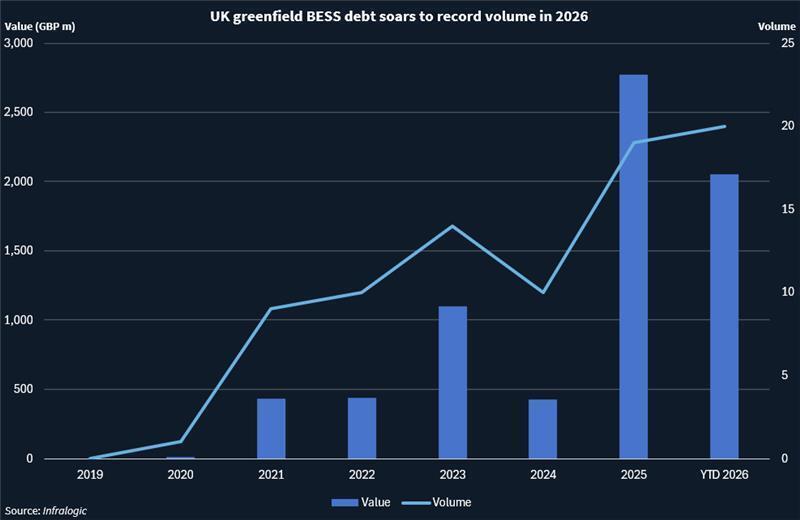
The evolution of the UK BESS market is uneven and complex, but the shift towards investment grade is clear.
| 80% of largest UK BESS financings have taken place since last year | ||||
| Transaction | Loan Debt GBP (m) | Date | Investor | MW |
| Thorpe Marsh 1.45GW Battery Storage Project | 593.84 | 08 September 2025 | EIG Global Energy Partners | 1,450 |
| Eccles 500MW Battery Storage Project | 245.00 | 28 March 2026 | Matrix Renewables (TPG) | 500 |
| Carrington 680MW Battery Storage Project | 234.90 | 06 November 2025 | Statera Energy (EQT Infrastructure) | 680 |
| Blackhillock and Kilmarnock 400MW Battery Storage Portfolio (Phase 1) | 234.00 | 15 February 2023 | Zenobe Energy (Infracapital, Tiger Infrastructure Partners) | 400 |
| West Burton C 500MW Battery Storage Facility | 233.00 | 17 July 2026 | Fidra (EIG Global Energy Partners) | 500 |
| Hunterston 400MW Battery Storage Project | 225.00 | 20 July 2026 | Revera (Carlyle) | 400 |
| Eccles 400MW Battery Storage | 220.68 | 27 February 2025 | Zenobe Energy (Infracapital, KKR Infrastructure) | 400 |
| Pulse Clean Energy Debt Raise (2025) | 220.00 | 31 July 2025 | IMCO | Undisclosed* |
| Constantine 612MW BESS Portfolio (2025) | 180.00 | 17 March 2025 | Constantine Group (AIMCo, Railpen) | 612 |
| Gresham House Battery Storage Portfolio Financing (2021) | 180.00 | 20 September 2021 | Gresham House Asset Management | Undisclosed* |
| *Pulse Clean Energy deal funded 700 MWh of new capacity. Gresham House deal funded seven new projects. | ||||
| Source: Infralogic | ||||
A service of 

Your M&A Future. Today
Explore unlimited content like this, available only in the platform.
Already a client? Sign in