Compute bottlenecks drive China’s big-ticket LLM fundraisings, AI agent M&A – Dealspeak APAC


- LLM players require large financings to secure scarce compute
- Investors favour profitable AI agents as they seek nearer-term returns
- Consolidation expected as funding concentrates on the winners
China’s race for AI self-sufficiency is entering a new phase of dealmaking, with large language model (LLM) developers pursuing ever-larger funding rounds as compute costs rise and access to advanced chips becomes more constrained, AI-focused investors and advisers told Mergermarket.
US restrictions on advanced AI chips, extended on Monday (16 November) to include access to overseas computing resources, are set to deepen compute shortages and intensify funding pressures across China’s LLM sector.
At the same time, pressure to monetise capital-intensive LLM investments with long payback periods is expected to accelerate application-layer acquisitions, with AI agent developers among the most sought-after targets.
Chinese AI-related M&A transaction volume has risen 15x year-on-year to a record USD 49.2bn across 209 deals, according to Mergermarket data. LLM developers accounted for 62% of total deal volume, worth USD 30.4bn across 38 transactions.
DeepSeek’s CNY 100bn (USD 15bn) funding round led by Tencent and CATL in October marked the year’s largest financing to-date. Kimi chatbot developer Moonshot AI has also been highly active raising about USD 6.2bn this year, including a USD 3.5bn Series F round.
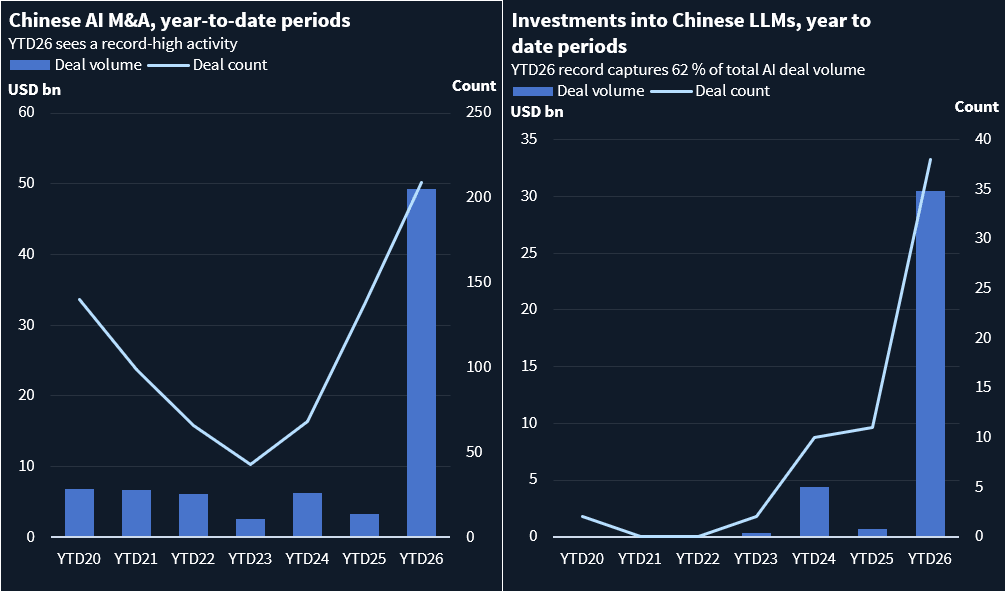
Source: Mergermarket, data correct as at 17-Nov-26
Source: Mergermarket, data correct as at 17-Nov-26
Restructured earnouts
“Many see 2026 as the first year of large-scale commercialisation for China’s AI agent players and M&A activity is expected to accelerate next year,” an industry banker noted.
When evaluating AI agents, said the banker, investors look for more immediate returns and so are prioritising near-term profitability over talent, model quality and compute capabilities. The EmbedWay-Shaue deal pioneered the trend, he added.
In June, EmbedWay Technologies, a China-based manufacturer of DPI front-end applications and systems, paid CNY 467.32m for a 51% stake in AI application solutions provider Shanghai Shaue Information Technology. The transaction stood out for its earnout, with Shaue’s founder group providing cumulative net profit commitments for the 2026-2028 period. This is a rare structure in Chinese AI M&A over the past two years, he said.
China’s enterprise-grade AI agent market is projected to grow from CNY 21.2bn in 2025 to CNY 332bn by 2029, effectively doubling in size each year, according to an April report by the Data Center Committee of the China Communications Industry Association.
Smaller LLMs face funding crunch
US export controls on advanced AI chips to China have tightened steadily since 2022, increasing both training and inference costs for Chinese foundation-model developers.
Chinese access to overseas GPU leasing is also coming under greater scrutiny under the new US rules.
On 16 November, the US Department of Commerce announced new rules to prevent Chinese AI developers from circumventing US chip export controls by remotely accessing data centres in third countries, especially in Southeast Asia.
These external restrictions are compounding an already difficult commercial environment, said a Chinese AI-focused investor. Despite China’s huge digital user base, consumers and enterprises have shown limited willingness to pay for software, depriving many LLM developers of sustainable revenue streams unless backed by deep-pocketed investors.
Recent declines in the Hong Kong-listed shares of leading LLM developers such as MiniMax Group reflect growing doubts over whether user growth and token consumption can translate into sustainable margins, they noted.
Shares in MiniMax, which went public in Hong Kong on 9 January 2026 at HKD 165 per share, have slumped nearly 70% from their IPO price compared to the Hang Seng Index’s 11% decline over the same period.
No more easy ‘big money’
“It no longer works to use early-stage revenue to justify late-stage valuations,” said one adviser.
The bubble has yet to burst for strategically important AI leaders such as DeepSeek and Moonshot AI, whose scarcity value continues to support elevated valuations. However, investors are becoming less willing to pay start-ups the outsized premiums seen during the earlier funding boom. Smaller players will become acquisition targets, he said.
China’s foundation-model sector attracted more than 200 entrants in its initial stages but has since shrunk to roughly 20 developers, the advisor added. Along with DeepSeek, Moonshot AI, and MiniMax, the remaining leaders include Z.ai, StepFun, as well as tech heavyweights Alibaba, Baidu, and ByteDance.
To stay technologically competitive, Chinese LLM developers must continue raising capital to secure compute resources for model training and inference, the PE investor said. However, “big money” is concentrating on the leading LLM developers and companies backed by cash generative tech heavyweights with businesses in advertising, online retail, video streaming or cloud services.
“It’s no longer the case that anyone with a model story can raise fresh capital easily,” he added.
Backing the full AI stack
Alongside Chinese state-backed funds, private equity firms HSG, Hillhouse and IDG Capital are among the major financial backers in AI tech firms.
Rather than betting on a single theme, said the AI-focused advisor, many are building exposure across the full technology stack, spanning foundation models, computing infrastructure, AI agents and emerging technologies such as optical communications and quantum computing.
They are securing positions at multiple critical links in the value chain to hedge against technological and geopolitical uncertainties, said the adviser.
A service of 

Your M&A Future. Today
Explore unlimited content like this, available only in the platform.
Already a client? Sign in