BASF’s Evonik retreat may prove short-lived – Europe Morning Flash


- BASF moved too soon on Evonik
- Politics, not rationale, killed chemistry
- Comeback possible in 2H27 if stars align
Well, that’s that. German chemicals giant BASF’s announcement yesterday (19 November) abandoning its EUR 11bn pursuit of Frankfurt-listed peer Evonik ends a fascinating saga encompassing regional and national politics, questions of European strategic autonomy and industrial resilience in a divided world.
Or does it? The Flash can’t help but wonder whether BASF CEO Markus Kamieth’s tilt at Evonik was premature, brought into the full glare of public debate too soon and running against a political timetable that was never in its favour.
A reminder: headquartered in Essen, North Rhine-Westphalia (NRW), Evonik is 44%-controlled by RAG-Stiftung, a foundation established to handle legacy liabilities relating to the German coal industry. Sitting ex officio on RAG’s board of trustees are NRW state premier Hendrik Wüst, Saarland minister-president Anke Rehlinger and the federal ministers of finance (Lars Klingbeil) and economic affairs and energy (Katherina Reiche), among others.
In short, this was a highly political affair. Especially so given much of the deal rationale hinged on securing significant job cuts – despite Kamieth’s best efforts to provide reassurance on that score.
Which made the timing of BASF’s pursuit especially baffling.
Wüst is popular in NRW but faces re-election in April. Viewed as a consensus builder within the centre right CDU party, he’s arguably the most likely candidate to replace the wildly unpopular Friedrich Merz as federal chancellor at some point in 2027.
In that context, how could Wüst support the deal? He’d need to have trusted the good folk of NRW to accept the nuanced argument that Evonik job cuts led by BASF would be better over the long term than allowing the chemicals industry to bleed out in the face of Chinese competition and other productivity challenges.
Thousands of motivated, unionised workers leveraging widely held economic anxieties would scarcely be the ideal backdrop for a successful campaign.
Much easier simply to oppose the deal and blather on about regional industrial strength and safeguarding workers’ positions. And that’s exactly what Wüst decided to do over the weekend.
So, could it be that original deal timing was disrupted by the widespread reporting of the prospective transaction, significantly advancing a timetable that had been planned for 2027, presumably after the NRW elections?
After all, this news service’s scoop on 21 September that BASF was pursuing Evonik kicked off a media frenzy that smoked out statements from both parties four days later.
It seems a compelling theory – especially given Evonik was enduring a significant management challenge. On 27 August, the group appointed Claus Rettig as interim CEO while the incumbent Christian Kullmann started recovery from unplanned surgery.
In terms of politics and Evonik stakeholders, the timing was hardly auspicious.
There were other issues. BASF’s EUR 22.15 and EUR 24.00 proposals never really looked goers on the valuation front. As the Flash has previously argued, peer comparisons indicated Evonik could be valued at 8x-9x EBITDA, implying an enterprise value close to EUR 16bn and fair value of EUR 24.80-EUR 28.80 per share.
That tallies with reports over the weekend that BASF would need to go to EUR 26-EUR 28 per share to have a hope of transacting.
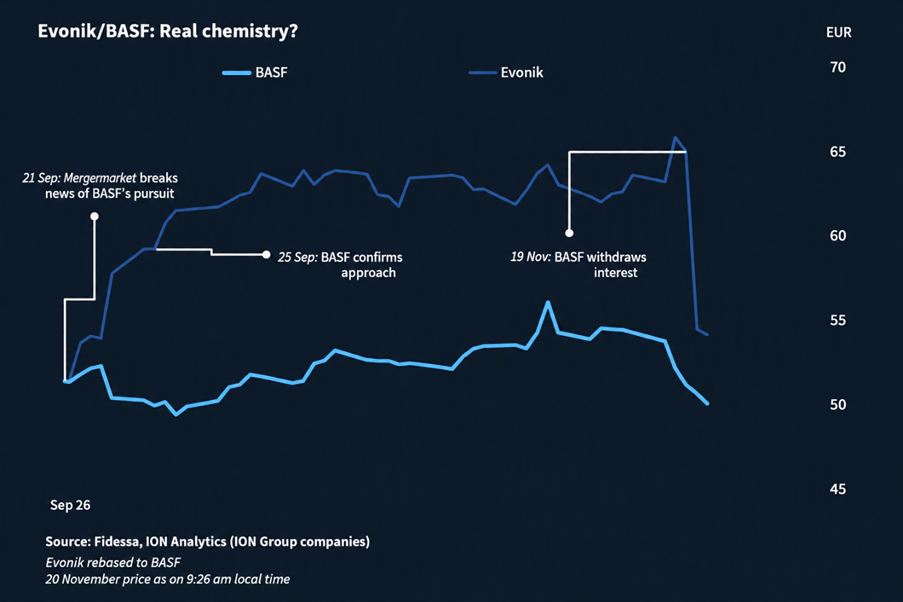
On top of market confusion over BASF’s strategy – having executed many disposals to get barnacles off the boat, here it was engaging in a transformational acquisition in specialty chemicals – the political, management and valuation obstacles were impossible to overcome.
And yet to the Flash, the deal rationale makes perfect sense.
BASF and Evonik share significant corporate DNA – they are German, of course, but they are also focused on quality products and have worked to streamline operations. Complimentary portfolios would create a unique offer across nutrition, health and care; battery materials and e-mobility; industrial coatings; and advanced materials.
In a beleaguered European chemicals industry under assault from cheap Chinese imports, both companies are performing well. In their latest earnings reports, BASF beat consensus with 3Q EBITDA before special items of EUR 1.6bn (up 14% year-on-year) and lifted guidance; Evonik narrowly missed consensus with 3Q adjusted EBITDA of EUR 629m, but this had climbed 40% YoY and the group upgraded the tone of its FY26 outlook.
Under President Ursula von der Leyen, the European Commission is desperate to see European champions emerge as global behemoths – and has drafted new merger guidelines with that goal in mind. It wants to see not only scale, but also resilience developed across the bloc. A BASF-Evonik combination would appear to fit the bill.
Once the dust has settled on the NRW state election, and we have visibility both on the German chancellorship and French presidency, the Flash would not be at all surprised if Kamieth made another attempt in 2H27.
Indeed, BASF’s pointed remark in yesterday’s statement that Evonik’s board had “not shown meaningful engagement” seemed to lay down the gauntlet to non-RAG shareholders to put pressure on the company to explain itself. They’ll be smarting with Evonik shares having fallen 16% in the past 24 hours.
So, keep an eye on this pair. Despite all the will-they-won’t-they energy, these two companies appear to have real chemistry.
A service of 

Your M&A Future. Today
Explore unlimited content like this, available only in the platform.
Already a client? Sign in