Advanced diagnostic imaging M&A advances as providers seek advantages of scale – Dealspeak EMEA


- 2026 deal counts at record highs
- Drivers for consolidation in a fragmented market
- Infrastructure funds more recent market entrants
Advanced diagnostic imaging (ADI) lights up as an M&A hotspot on the screen, as platform providers scale and expand to enable them to serve the whole patient journey.
“We expect a lot of momentum in this market in the next 12-18 months”, says Dirk-Oliver Löffler, managing director and co-head of European Healthcare at Lincoln.
European, as well as global, M&A deal counts in the space are at record highs, with 61 transactions in Europe so far this year, compared to 56 for the same period in 2025, Mergermarket data shows.
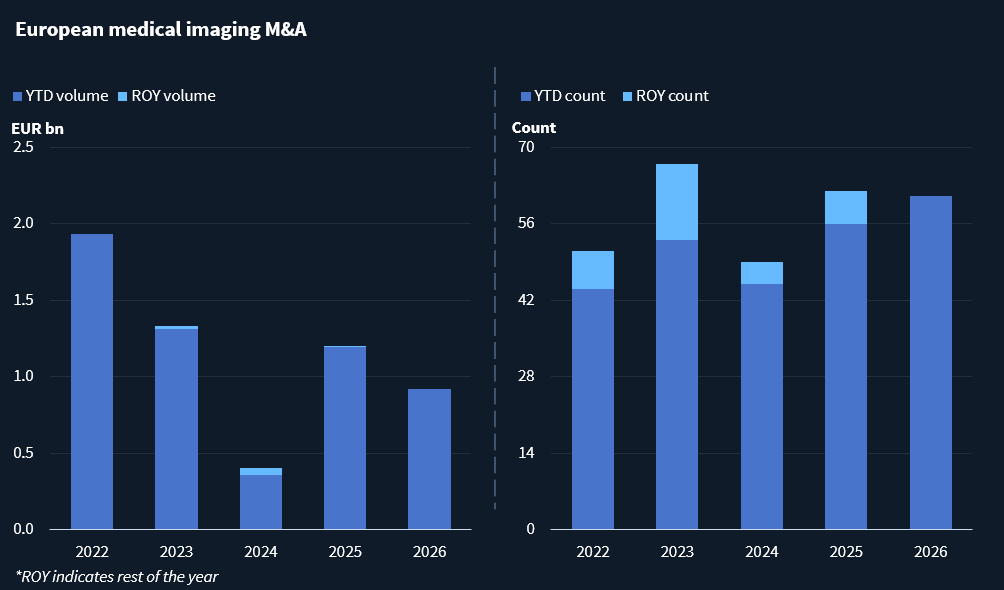
Source: Mergermarket, data correct as at 13-Nov-26.
Globally, there have been 148 deals – an all-time high – with aggregate value hitting EUR 15.1bn this year to date, the third-highest on record, following YTD25 and YTD20.
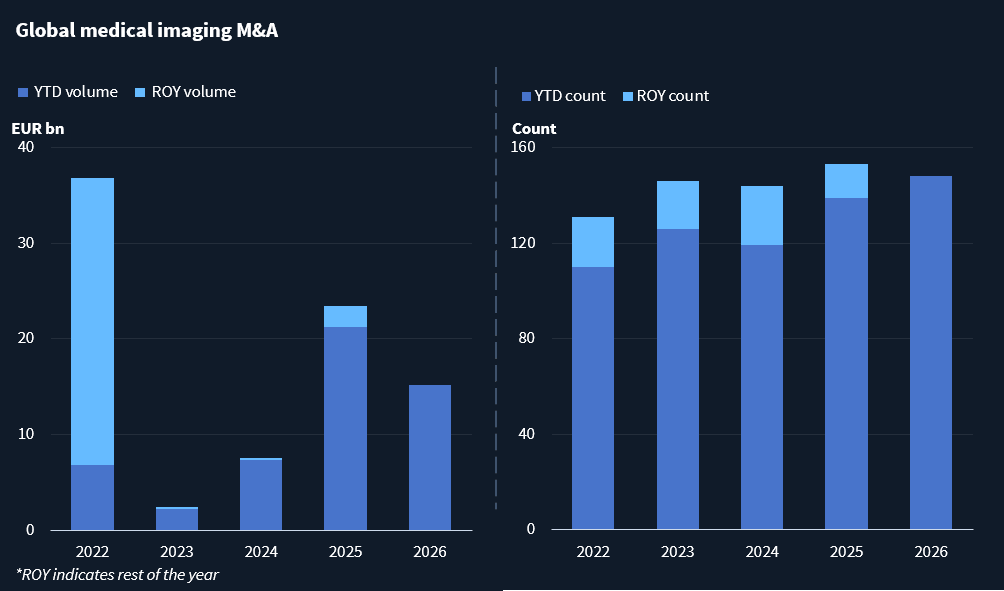
Source: Mergermarket, data correct as at 13-Nov-26.
Advanced diagnostic imaging refers to specialized, high-resolution techniques to produce detailed images of the inside of the body. This is used for diagnosing and monitoring health conditions like cancer, heart disease, and neurological disorders, among many others.
Techniques include MRI (magnetic resonance imaging), CT (computerised tomography), and PET (positron emission tomography). Nuclear imaging, using radioactive material, is becoming more common, and is used in oncology, among other areas. The ADI concept does not include standard X-ray and ultrasound.
Consolidation in a fragmented market
Demand for medical imaging continues to grow, supported by the usual suspects among structural growth drivers in healthcare: an ageing population, increasing prevalence of chronic disease, growth of preventative medicine, greater reliance on diagnostic data in clinical decisions, technological innovation, and AI integration.
The ADI market is fragmented, with a large number of independent providers alongside a growing group of scaled platforms, says Löffler and his colleague, Director Andreas Roth.
There are several drivers for consolidation in this fragmented market, such as requirements for investment into equipment and technology, talent recruitment challenges, increasing compliance requirements, and the advantage with broader referral networks, they say.
“The sentiment is changing a bit. There’s a bigger focus on being patient-centric and serving the entire patient journey”, Löffler says.
Interest from infrastructure investors
Among investors, both strategics and buyout funds are prevalent, alongside infrastructure funds in recent years, according to Löffler.
“We observe Asian, US-based and European players investing in the European market”, Löffler says.
Löffler and Roth see a continuing trend of single-country players becoming international by expanding to new geographies. Alternatively, companies stay in their home market but expand to new technologies and indications. At the top of the food chain, we find players that have evolved into fully integrated multinational and multi-indication outpatient platforms.
One such player is Affidea, for which sponsor GBL has mandated Rothschild and Goldman Sachs for an exit, as reported by Mergermarket in June.
Affidea is being circled by large-cap PE funds like Cinven, CVC, Partners Group, Blackstone and Bain Capital, as reported. Meanwhile, Affidea continues to consolidate the market, having acquired two Alliance Medical diagnostic centres in UK last month.
However, this is a complex market to invest in, given regulatory frameworks and developments in payor structures, and no two geographic markets being the same, Löffler cautions, adding that investors have to do careful due diligence.
“Only in Switzerland, you have 26 cantons with different regulatory environments within each. Each one has different regulatory hurdles to opening a new centre”, Roth says.
Aside from Affidea, other European consolidators include Alliance Medical, Evidia, Sanecum, ImaOne, and Quartz Healthcare. These demonstrate the ongoing evolution of the sector toward larger, more sophisticated operating platforms.
Ongoing deals
Plenty of European medical imaging businesses have been in play this year.
Warburg Pincus is exploring a sale of its German medical diagnostics platform Oyora, and has mandated Goldman Sachs, according to a Mergermarket report from June.
French, Andera Partners-backed radiology business Résonance Imagerie hired Crédit Agricole CIB as sellside advisor, as picked up by this news service in July.
RAISE appointed ODDO BHF to sell its stake in French nuclear medicine group Lutecia Care, with IMs circulated in May, as reported by Mergermarket.
French medical imaging company ImaOne appointed ODDO BHF to find a new investor, as also reported here in May. The process moved towards a hybrid capital deal with Apollo, however a ruling by the French Council of State to deregister two of its clinics puts the deal at risk, we revealed last month.
Sanecum’s owner Adiuva Capital mandated Houlihan Lokey to explore strategic options for a capital raise for the German outpatient medical care platform, aiming to raise EUR 250m, as reported by Mergermarket in July.
Rivean Capital has agreed to buy Austrian medical imaging group Diagnostikum, after fighting off competing infrastructure investors, according to our report last month.
Montefiore Investment-backed, French radiology group imaGen mandated Rothschild to seek a new investor, as reported by Mergermarket early this year. In June, the company was in exclusive negotiations to be acquired by Vidi Capital.
A service of 

Your M&A Future. Today
Explore unlimited content like this, available only in the platform.
Already a client? Sign in