
Global Fundraising Report 3Q26 – Mega fund closes driving volumes


- Large fund closes drive volumes, with KKR and Partners Group leading the quarter
- Fundraising slows down compared to record 2025, with a 39% decrease
- Smaller funds face challenges as LPs favor larger managers
Large fund closes powered a rebound in global infrastructure and energy fundraising in the third quarter of 2026, although it fell short of the amount raised last year.
Global unlisted, closed-end infrastructure funds reached USD 65.5bn in final closes in 3Q26 across 17 vehicles, driven by three large funds closing that accounted for 64.5% of quarterly fundraising.
The total includes three continuation vehicles, which collectively raised USD 5.2bn. The other 14 funds raised USD 60.4bn.
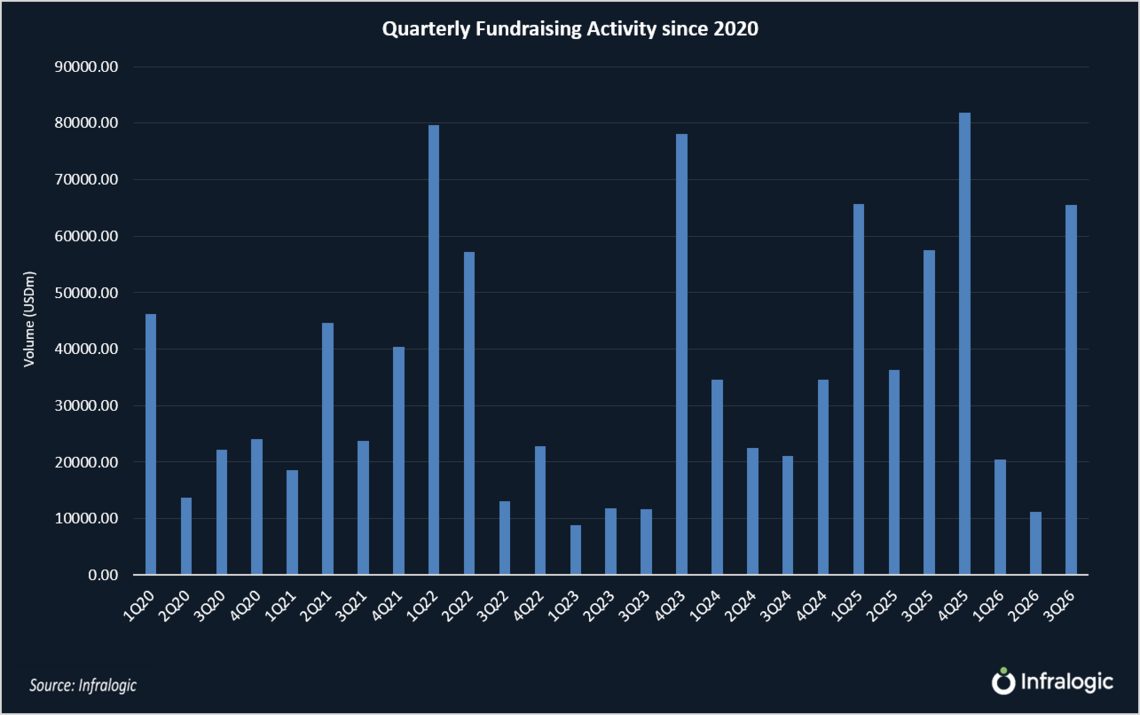
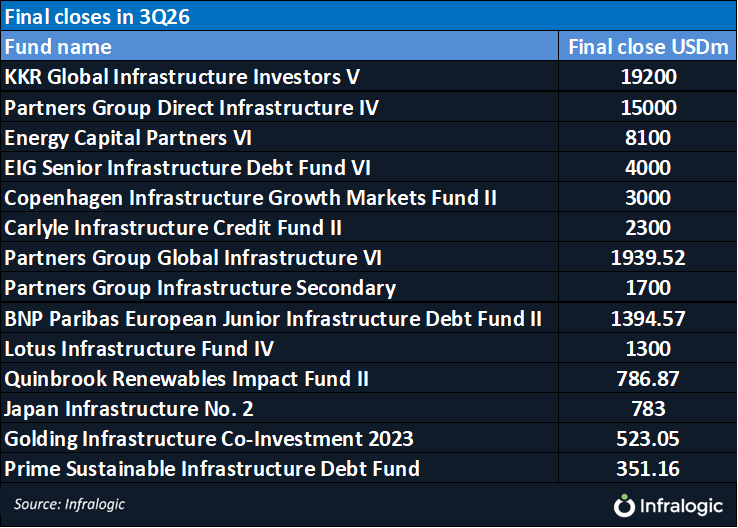
KKR Global Infrastructure Investors V led the quarter with a USD 19.2bn close, followed by Partners Group Direct Infrastructure IV at USD 15bn and Energy Capital Partners VI at USD 8.1bn. The quarterly total was more than twice the USD 31.6bn raised in 1Q and 2Q 2026 combined.
However, fundraising has been slower than the record 2025 when USD 159.5bn was raised in the first three quarters versus USD 97.2bn for the same period this year, some 39% lower.
The total reflects final closes of closed-end, unlisted funds globally across the infrastructure, renewable energy, transition, and power and energy asset classes.
Alasdair Maclay, partner and global head of real assets and private equity advisory at FIRSTavenue, said the quarterly rebound largely reflected the timing of large fund closes.
“The strong quarter is undoubtedly mostly about the timing of those mega funds,” he said. Outside those vehicles, he saw limited evidence of stronger fundraising momentum.
Excluding the three large fundraises, the remaining funds raised USD 23.2bn in 3Q26, up 1.9% from USD 22.8bn in 3Q25.
Funds closing below USD 1bn raised USD 3.1bn in 3Q26, down from USD 6.6bn in 3Q25.
Maclay said LPs’ decisions to concentrate commitments among fewer, larger managers were reducing the capital available to smaller funds.
“There’s no doubt that the mega funds take share away from the smaller funds,” he said.
Capital raised by funds closing at USD 1bn to below USD 5bn was broadly unchanged at USD 20.1bn, compared with USD 20.2bn a year earlier.
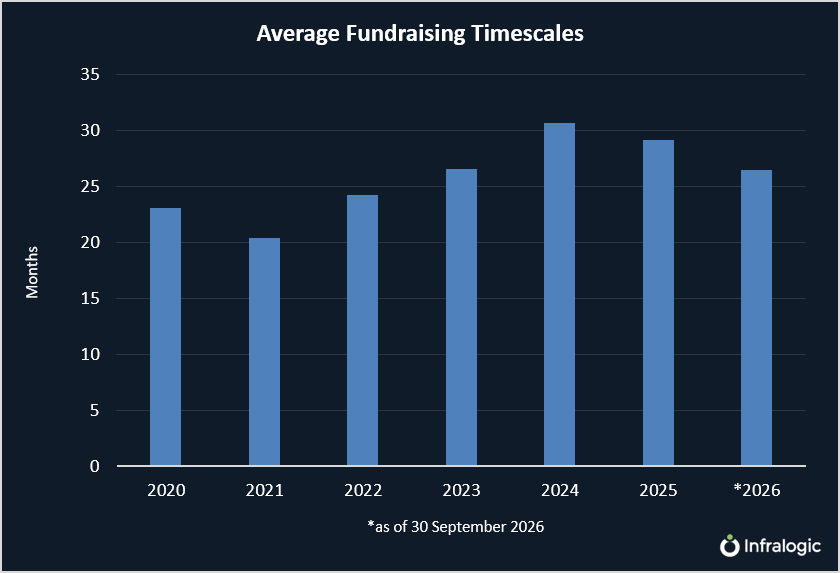
Funds with available timeline data took an average of 24.7 months to reach final close in 3Q26, compared with 27.5 months in 3Q25. Both averages cover 15 funds and include continuation vehicles. KKR’s fundraising took 34 months and Partners Group’s 30 months, while ECP completed its raise in 14 months.
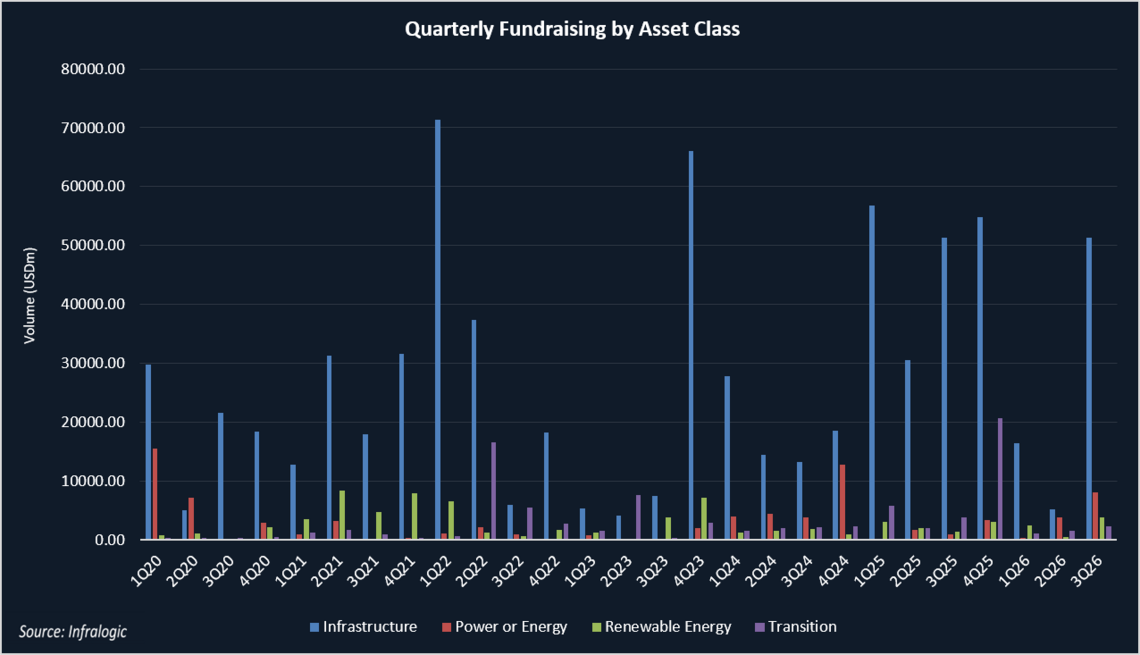
Infrastructure remained the largest asset class, raising USD 51.3bn, broadly unchanged from USD 51.4bn in 3Q25. The increase in overall fundraising came from power and energy and renewable energy vehicles.
Renewable energy funds raised USD 3.8bn, up from USD 1.4bn, with Copenhagen Infrastructure Growth Markets Fund II contributing USD 3bn. Transition fundraising declined from USD 3.8bn to USD 2.3bn.
Maclay said growing electricity demand, including from data centres, was creating opportunities to develop new assets. Battery storage was also expanding the investment opportunities available to energy transition funds, while some managers were broadening their renewables strategies to include higher-return investments. “We’re finally in a growth phase,” he said.
Global and OECD-focused vehicles accounted for 55.1% of quarterly fundraising, with a further 22% raised by funds targeting both Europe and North America. The regional breakdown reflects where funds intend to invest, rather than where they have deployed capital.
Equity funds accounted for 80% of 3Q fundraising, while debt and credit strategies represented 13%.
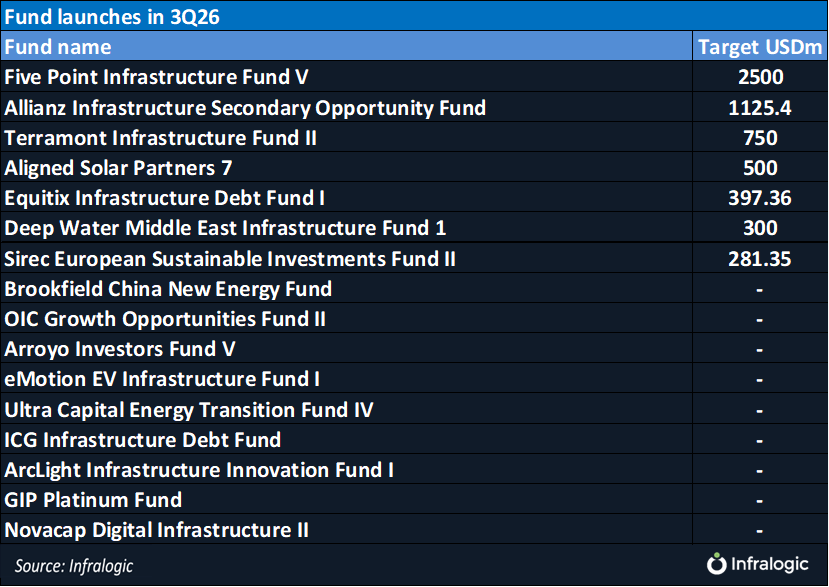
Seventeen funds launched in 3Q26, down from 24 in 2Q26, 25 in 1Q26 and 31 in 3Q25. Seven disclosed targets totalling USD 5.9bn.
Five Point Infrastructure Fund V had the largest disclosed target at USD 2.5bn, followed by Allianz Infrastructure Secondary Opportunity Fund at USD 1.1bn and Terramont Infrastructure Fund II at USD 750m.
Targets were not disclosed for the remaining nine launches.
The quarter’s concentration highlights how the timing of a handful of large fund closes can shape fundraising volumes. KKR and Partners Group’s two vehicles alone raised more than the entire first half, making their contribution central to the rebound.
Whether that momentum extends to smaller funds will be the test in 4Q.
Maclay did not expect a sharp increase in mid-market fundraising in 4Q. “I don’t think there’s a strong argument to think that suddenly there will be a sort of bump in the mid-market in Q4,” he said.
He saw stronger prospects for infrastructure secondaries, supported by LP demand for liquidity and capital available for deployment. “There’s quite a wall of money encouraging secondaries and CVs,” he said.
A service of 

Shape your future with Infralogic. Today
Explore unlimited content like this, available only in the platform.
Already a client? Sign in