GCC data centre investment opportunity at a crossroads


- SWFs drive data centre development through partnerships with international funds
- Hyperscalers seek stable revenue and demand for GCC data centres
- Debt financing agreements support growing GCC data centre demand
The GCC region offers the best and worst locations to build AI data centres at the same time. On the one hand it has abundant, cheap energy and vast unproductive land, on the other it is one of the world’s most water-scarce and geopolitically sensitive regions.
This contradiction has not stopped the GCC states, primarily the UAE, Saudi Arabia and Qatar, from launching multi-billion-dollar initiatives to develop and export AI capabilities, now an important pillar of their economic diversification, energy and national security agenda.
The US-Iran war, which inflicted major damages and permanently disabled some of Amazon Web Services’ (AWS) data centre facilities in the UAE and Bahrain, has done little to diminish this ambition.
In Abu Dhabi, the construction of the first 200 MW phase of the 1 GW Stargate data centre – an initiative by Abu Dhabi AI fund MGX, Softbank, OpenAI and Oracle – is proceeding at full steam, a testament to the UAE’s unchanged AI resolve.
The region’s top sovereign wealth funds (SWFs) are pulling out all the stops to support the development of AI and digital infrastructure through their designated national AI champions.
Mubadala backs Abu Dhabi’s AI holding company G42, which aims to build at least 5 GW of data centre capacity including through its unit Khazna Data Centres, while Public Investment Fund (PIF)- and Aramco-backed Humain aims to build 3 GW by 2030, and twice that figure by 2034.
Both firms invest across the full AI value chain, from developing Arabic large-language models (LLMs) and AI applications for public and private users, to building and operating their own data centres. They have also locked in substantial volumes of advanced processors with US chip manufacturer Nvidia – an important competitive advantage.
The private sector has also been expanding their data centre capacity in anticipation of increased demand from national AI firms and local enterprises, as well as global companies, which need to comply with data sovereignty requirements to expand their presence in the region.
Qatar’s Ooredoo spin-off Syntys, Saudi Arabia’s DataVolt and Quantum Switch Tamasuk, and the UAE’s Gulf Data Hub (GDH) and Damac Digital, formerly Edgnex, are some of the names actively expanding their capacity and pursuing offtakers for planned and under construction facilities.
| Middle East top data centre operators | |||||
| Company | Main investor | HQ | Number of live data centres | IT load capacity (MW) | Planned or under construction DCs |
| Khazna Data Centres | Mubadala through G42, MGX, Silver Lake | Abu Dhabi | 30 | 673 | 6 |
| Center3 | STC (majority owned by PIF) | Riyadh | 10-15 | na | na |
| Gulf Data Hub | KKR, Tarek Al Ashram | Dubai | 5 | 46 | 15 |
| Quantum Switch Tamasuk | Tamasuk, Quantum Switch | Riyadh | 4 | 30 | na |
| DataVolt | Vision Invest | Riyadh | na | na | 4 |
| Damac Digital | DAMAC | Dubai | 8 | na | 14 |
| Equinix | BlackRock (minority shares) | US | 5 | 31 | na |
| Du | Emirates Investment Authority, DH 8 (Emirates Communications & Technology Company) | Dubai | 5 | na | 1 |
| Syntys | Ooredoo (Qatar government majority-owned) | Qatar | 26 | 29.6 | 1 |
| Al Moammar Information Systems | Al Moammer family | Riyadh | 5 | 32 | na |
Sources: Company press releases and websites, news websites
Yet, except for KKR’s acquisition of a stake in GDH last year, including a commitment to “support over USD 5bn of total investment”, most global infrastructure funds have kept the region at arm’s length.
The Gulf’s SWFs are ready to write large cheques to back international GPs willing to invest in projects locally, but GPs are still very cautious.
“Not many people are willing to talk about it, but taking capital from Middle East SWFs and then investing that same capital back into the region entails significant risks, especially when something seriously goes wrong such as what has happened [during this US-Iran war],” a senior executive with a major US infrastructure investor told Infralogic.
The executive said his firm has considered investing in or acquiring data centres in the Gulf in the past but decided against it on each occasion. Without a solid plan to generate returns, or a clear exit strategy, giving in to the pressure to deploy locally risked resulting in poor investments and ultimately jeopardise relationships with SWFs themselves.
Few attractive investment opportunities have materialised so far. A Gulf-based infrastructure investor, for instance, withdrew from bidding for a deal this year because the asset under consideration “did not fit our investment criteria”.
“We were looking for a stable revenue and actual demand or offtake, not an asset that was built speculatively,” the source told Infralogic, with the caveat that other investors might have higher risk appetite.
Power advantage
Yet expectations that this would change and more good projects would materialise is high.
The notion that data centres will go where energy is available and cheap already set off a regional data centre frenzy in the late 2010s.
Bahrain and Dubai completed fiercely to win the contract to be the first location of AWS’ Middle East availability zone, a series of redundant data centre facilities that host Amazon and third-party data and applications, back in 2017.
Bahrain prevailed, with AWS’ facility there completed in 2019. The US tech giant went on to build a second availability zone in the UAE, with one data centre in Dubai and two in Abu Dhabi in 2022.
While two of these four facilities have become a collateral damage to the US-Iran war, this incident did not necessarily demolish the business case on which they were built in the first place.
“The Gulf’s competitive advantage lies in its energy resources and its ability to deliver electricity and infrastructure faster than many competing markets,” Jessica Obeid, founding partner at Dubai-based New Energy Consult, an independent consultancy, explained, adding that hyperscalers are looking for abundant available electricity and fast connection.
“Some Gulf markets, specifically Saudi Arabia and the UAE, can provide a grid connection to AI data centres in less than two years, whereas the queues in some parts of the United States extend beyond seven years,” she noted.
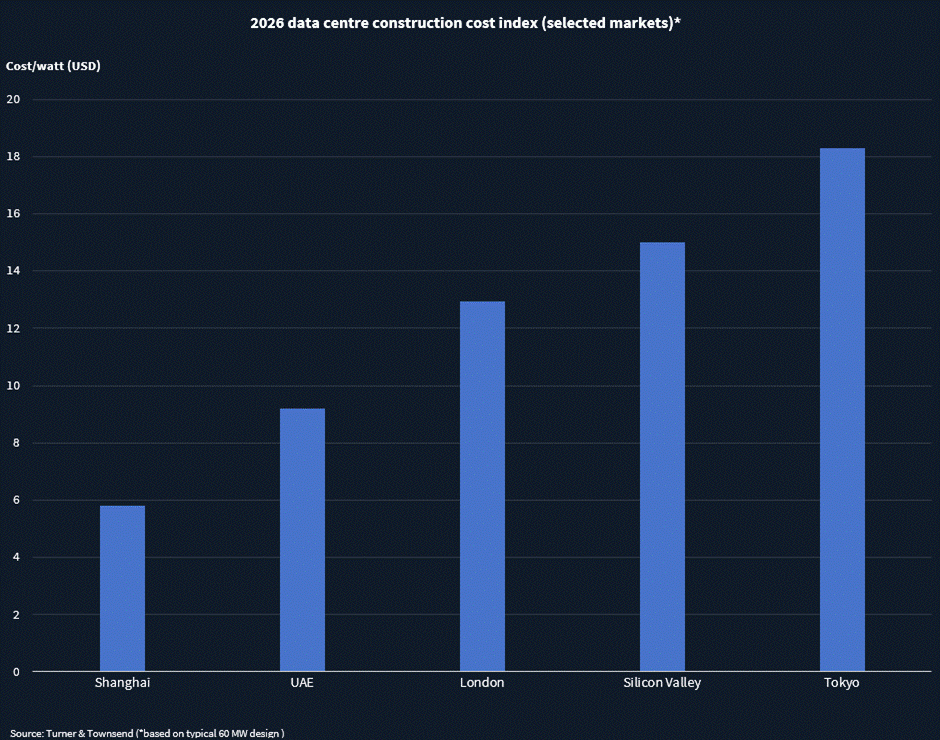
The Middle East also stands as one of the world’s most competitive regions in which to build data centres, according to Turner & Townsend’s latest annual data centre construction cost index.
At just USD 9.2 a watt, data centre construction cost in the UAE is 29% lower than in London (USD 12.95), and around half what it costs in Tokyo (USD 18.2).
One disadvantage for GCC developers lies in cooling, in a region with scarce water resources and high temperatures. Most water is obtained through desalination, and even though its costs are not prohibitive, the environmental cost can be a consideration for some investors, said Obeid.
“In the Gulf in particular, sustainability of resources is a key requirement for AI infrastructure scaling-up since these data centres require mostly liquid cooling, and cooling adds pressure to electricity demand,” she told Infralogic.
Security is clearly another concern given the region’s volatility, as highlighted by Iran’s attacks on AWS’s facilities. Data centres are increasingly seen as assets of strategic importance and can become easy targets in a conflict. Local developers are looking at ways to mitigate this.
“They will build in more contingency measures [into these facilities], consider multiple geographic locations, and more protected installations, possibly underground builds,” a Dubai-based expert said.
Another independent consultant told Infralogic that building more smaller facilities, rather than fewer large ones could also help. “They should opt to build as many data centres as they can, so that an attack on one or two assets will not cause enough pain,” he said. “In this way, you get to manage the geopolitical risk associated with these assets.”
Finding the tenants
The other good news is that today there is immediate demand for more computing capacity in some GCC countries, according to Kurt Davis Jr, managing director for EMEA Capital Advisory at consultancy firm Alvarez & Marsal.
With installed data centre capacity footprint of roughly 410 MW, Saudi Arabia has around 12 watts of data centre capacity per capita, compared to the US and UAE’s 50 watts. This is “a buildout waiting to be financed” rather than a speculative growth forecast, Davis told Infralogic.
There is also a contrarian case where uncertainty created by the US-Iran war could increase, rather than diminish demand for certain critical workloads in the region, including defence and cybersecurity, according to Ross McKenzie, CEO at Dubai-based RMA Advisory, a financial and technical consultancy focusing on infrastructure in the region.
Current data centre investors in the Gulf, as elsewhere, are split into two broad categories. The hyperscalers, which can build and finance their own data centres, like AWS did in Bahrain and the UAE, and private or state-backed data centre operators (DCOs), which build capacity and lease them to the hyperscalers and other third-party organisations.
Similarly to other regions, new projects are increasingly built by DCOs rather than tech companies, which want to avoid burdening their balance sheets with too much debt. The catch, however, is that investors “underwrite contracted megawatts, not announced megawatts”, Davis noted, meaning they want firm and bankable offtake agreements, preferably with hyperscalers.
And despite the need for more computing power in Saudi Arabia as highlighted by Davis, there is still considerable uncertainty over the region’s overall demand and offtake appetite, McKenzie added.
“The largest regional opportunities are predicated on international workload strategies rather than local demand. The population sizes simply do not compete with US, Europe and Asia, except for Egypt,” he said.
This is leading to intense competition to attract the best tenants, with all regional developers chasing the same demand from the hyperscalers and emerging neoclouds.
Few firm agreements with tenants for GCC projects have emerged so far. One recent deal was a preliminary offtake agreement signed last month by Humain and DataVolt with Netherlands-based AI cloud company Nebius. The deal covered half of a 100 MW AI campus planned to be built in Oxagon, an industrial complex within Neom in northwestern Saudi Arabia.
Sovereign wealth fund advantage
A unique feature of the GCC’s data centre market is the dominant role of sovereign wealth funds, which control some of the biggest developers and provide a large part of the capital.
The sovereigns also heavily control chip availability for AI workloads, which could limit the breadth of opportunities for other players.
For international infrastructure funds looking for targets, this means there are few credible partners and players to pick from, and those partners believe it is a buyer’s market for investment, according to McKenzie.
The largest global investors are indeed largely choosing to partner with sovereign wealth funds.
DigitalBridge was one of the first movers, signing a partnership with PIF to invest in GCC data centres back in 2023. BlackRock’s GIP followed suit in 2024, teaming up with MGX for an “AI Infrastructure Partnership” and later adding the Abu Dhabi Investment Authority (ADIA) as another investor.
Deals accelerated last year. Humain and Blackstone-backed AirTrunk agreed to develop data centres in Saudi Arabia with an initial investment of USD 3bn, while Brookfield Asset Management joined forces with Qatar Investment Authority’s subsidiary Qai in a USD 20bn AI infrastructure JV.
The scale of these deals was staggering, but in many cases most of the capital flows abroad.
The BlackRock/MGX AI Infrastructure Partnership said it wanted to mobilise USD 100bn of investment including equity and debt, but it mostly targeted US projects. The Brookfield-Qai tie-up also said it would invest in Qatar and select international markets, although their first investment is a GBP 2.5bn data centre project at the Drax Power Station in the UK.
More similar JVs could follow, according to a Gulf-based legal advisor, who suspects that other global infrastructure funds are currently holding talks with the region’s SWFs.
If these JVs advance local projects, the main beneficiary is likely to be the UAE, followed by Saudi Arabia and Qatar, as they have the clearest long-term strategies and supporting track record, according to McKenzie.
While none of these investors have disclosed their internal rate of return (IRR) targets for GCC data centres, given the greenfield nature of the market McKenzie estimated that projects are still mostly an “opportunistic” play with IRRs hovering roughly around 15%.
Sourcing the financing
Debt investors are also on the lookout for opportunities, and are asking themselves many of the same questions.
A handful of pathfinder financings by private data centre developers have already been agreed or are under way, but the market is still in its infancy.
Last year, Oaktree-backed Pure DC agreed a USD 250m financing underwritten by SMBC for a 40 MW project on Abu Dhabi’s Yas Island, while DataVolt has started pursuing long-term project financing for projects in Riyadh and Neom.
The largest deals are at platform level. KKR’s GDH last year raised USD 1.2bn of debt from local lenders, Japan’s SMBC, and France’s Credit Agricole and Natixis, while the UAE’s Khazna secured USD 2.6bn of loans with tenors up to 10 years from Abu Dhabi Commercial Bank (ADCB) and First Abu Dhabi Bank (FAB).
Saudi Arabia’s Humain has instead turned to the state-backed National Infrastructure Fund, signing a USD 1.2bn financing framework agreement earlier this year for 250 MW of AI data centres. It is also working to raise a fund with BSF Capital, the investment arm of a local bank, that could invest both equity and debt in its projects.
More financings are expected to come. Getting Saudi Arabia from the current capacity of 410 MW to 1 GW by 2030 would take USD 3.5bn to USD 7bn of debt, estimated Alvarez & Marsal’s Davis.
While this is large compared to the size of deals agreed so far, it is less than 1% of the private-sector loan book and easily absorbed, he added. Combining all announced projects across the GCC, the figure rises, however.
“Delivering even half of what’s been announced takes between USD 14bn and US 32bn in debt and around USD 10bn and USD 14bn in equity, and no sponsor funds that internally,” said Davis.
To meet this demand, developers will explore various debt instruments – bank loans, sukuk, private credit – and “sponsors who source for and sequence them at the outset can raise on better terms”.
Watching out for more tenants
The road ahead for infrastructure funds looking to invest in data centre assets in the Gulf will remain tricky.
Despite its unique features, the Gulf data centre market cannot be seen in a vacuum. Amid a global “feeding frenzy” among investors, projects in the GCC must compete for attention with opportunities elsewhere.
“We hear very regularly that teams are flat-out assessing deals globally and so anything from this region needs to really stand out,” noted McKenzie. “Even regional players who are active internationally like Damac Digital, DataVolt, Khazna and Syntis are having to balance regional and international opportunities.”
Despite this, there is a perception that investors and hyperscalers that are already committed in the region will not backtrack. Microsoft, for one, announced in September that it plans to invest over USD 10bn in AI infrastructure across Saudi Arabia, the UAE, Kuwait and Qatar over the next three to four years.
As long as more hyperscalers follow suit, the GCC data centre investment opportunity will continue to grow.
A service of 

Shape your future with Infralogic. Today
Explore unlimited content like this, available only in the platform.
Already a client? Sign in