Democrats’ gains in midterms cause heartburn for data center developers


Rather than threatening demand for AI infrastructure, the US midterm election results increased the premium on data center projects with power, permits, and a clear path to construction as investors and developers reassess risk.
Last week, the US midterm election results, in which the Democrats took control of both the House and Senate, as well as many governorships, reflected the public sentiment on the sector.
“Data centers were clearly on the ballot,” said Logan Goldie-Scot, vice president of strategy at Generate Capital.
The results, particularly at the state level, may delay or even kill some data center projects that do not have all their permits in place. But some sector professionals question whether anti-data center rhetoric on the campaign trail will translate to action once officials are in office.
“I’d anticipate status quo and political posturing, but not actual change,” one industry lawyer said.
State of play
While the US Senate and House both flipped from Republican to Democratic control, the state-level elections had greater implications for data center developers and sponsors, experts say.
“The more significant result was at the state level,” said Keith Martin, partner at Norton Rose Fulbright. “The fact that Democrats took over in Texas, Ohio, and Georgia, that is where most of the activity will be.”
The election amplified scrutiny of data center development, especially in those key markets, all three of which saw major Democratic flips at the state and federal levels. All three states will see new governors-elect take office in January – Keisha Lance Bottoms in Georgia, Amy Acton in Ohio, and Gina Hinojosa in Texas – who have all called for new or enhanced data center moratoriums upon taking office.
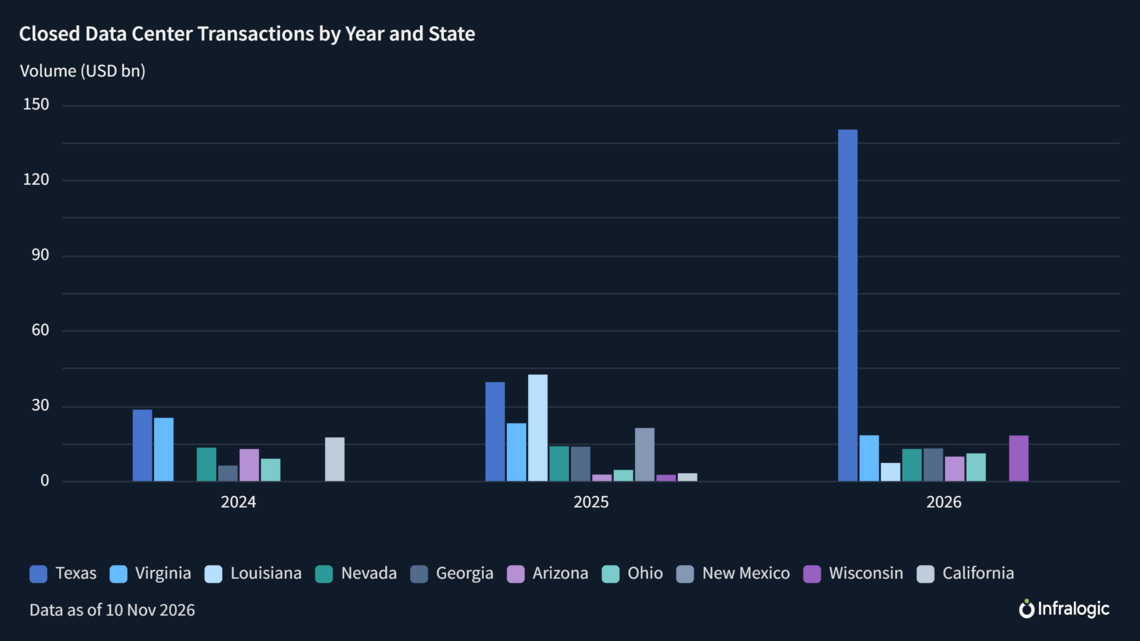
Additionally, voters in at least 29 jurisdictions voted for data center bans or restrictions, with only one local measure, in North Dakota, passing in favor of development, according to a report published by King & Spalding on 6 November.
As a result, questions surrounding the sector because of the election have made headlines over the past week. But industry experts told this publication that the biggest question is not whether AI demand will continue, but which projects can still reach construction on schedule.
“I think for the first six months of the year, while we’re waiting for policies to be enacted, [the biggest bottleneck] is going to be uncertainty,” one established data center developer said.
Overall, the market appears to be interpreting stricter oversight of data center development as a threat to the sector’s growth rather than an effort to shape how projects are built, a researcher at a major investment bank said. The sentiment that data centers must “pay their own way,” both when it comes to power and water, seemed to be the main point of political opposition, he added.
The cloud of uncertainty hanging over data centers may end up being more disruptive to the sector than any potential future requirements, the data center developer said.
“As long as we all have a clear set of ground rules, I think we’re going to be okay,” he noted.
“It’s a continuation of a dynamic rather than something that is inherently new,” added Goldie-Scot. “Feelings around data centers have generally been bipartisan in terms of voter sentiment.”
Several experts said the election results should not be viewed through a traditional partisan lens.
“The convergence of rural concerns about all forms of development at issue—new generation, new transmission, and new data centers—could interestingly align political goals across the partisan spectrum,” said Winston Skinner, a Texas-based partner at Vinson & Elkins.
Those concerns increasingly center on electricity affordability, grid capacity, water use and local control.
“I expect the upcoming Texas legislative session to focus on whether county and/or municipal level approvals should be required to authorize data center construction,” Skinner added.
Goldie-Scot underlined that pushback from communities and governments is not a new hurdle for the data center space; this is a sentiment that has been building over the past year or so.
Data centers were already facing these headwinds ahead of the election. In September, Oracle issued a force majeure notice for its USD 165bn Project Jupiter campus in New Mexico, the key hurdle being the denial of several permits for its behind-the-meter fuel-cell microgrid being developed by Bloom Energy.
Before flipping Democratic, Texas Governor Greg Abbott halted data center permits from the Texas Commission of Environmental Quality (TCEQ) until ERCOT and the PUCT complete audits of the process.
“It is becoming harder to build data centers,” Goldie-Scot said. “Because of the financial backdrop, the challenges connecting to the transmission system, rising community opposition, the inexperience of developers, and equipment procurement.”
Regardless of the hurdles the difficulties the market has faced, the midterm elections highlighted that community pushback is not something to underestimate.
While there is a national debate regarding a bill that could regulate AI infrastructure buildout, the Bipartisan American Affordability and Jobs Act, potential state-level actions remain the industry’s primary focus.
“I expect greater differentiation among markets, but a simple red-state versus blue-state map will miss important risks,” said Carl Fleming, global co-head of McDermott Will & Schulte’s energy and project finance group. “State policy, local land-use decisions, utility requirements and community attitudes can point in different directions.”
“State and local decisions are going to matter much more to developers and investors than federal ones for the next few years,” said Goldie-Scot.
Martin similarly said he does not expect Congress to take dramatic action against the sector.
“I don’t expect Congress to enact a data center moratorium,” he said, “mainly because the size of the Democratic sweep has insulated House and Senate leaders from pressure from the progressives.”
Too advanced to fail?
Data center developments fall into two camps post-election, according to Ari Pribadi, global co-head of investment banking for Marathon Capital.
Developers and sponsors whose projects should not be affected by last week’s results – either because they are in states that did not flip unexpectedly or because their projects are likely too far along to be stopped – may benefit from the swing, particularly in Texas.
“It is going to be an increased value and demand for the ones that are not subject to post-January 19 uncertainty,” Pribadi said, referring to the Lone Star State’s inauguration day.
Data center developments in Texas and other jurisdictions facing tighter restrictions on construction won’t necessarily die altogether but may take longer to build, he added.
Well financed projects, including those that qualified for ERCOT’s Batch Zero, are expected to be able to wait out the current audit placed by Governor Abbott, according to King & Spalding’s report from last week.
“Some of this depends on how Governor Abbott decides to react,” said Skinner of Vinson & Elkins. He noted that the governor could lift the data center pause once the audit is complete on 10 December or he could leave it for the governor-elect to manage.
The governor-elect’s authority may be more limited than many market participants assume, said Skinner.
“She likely does not have actual legal authority to unilaterally impose restrictions; like Governor Abbott, any directives to agencies like ERCOT and PUCT would derive not from formal legal authority, but from the power to persuade those agency heads,” Skinner added.
Unlike Abbott, who worked with agency leaders aligned with his administration, Hinojosa will inherit agencies led by officials appointed under a different governor, potentially limiting her ability to shape policy through informal directives alone.
“The demand is still there, but the timeline is going to be longer,” Pribadi said. “Unfortunately, speed to compute is so important in this industry that it might necessitate an end user to go elsewhere.”
And there is a situation where projects already underway, even with financing, could be materially affected or delayed.
“Recent Republican-led state legislation has focused on removing local control over a number of items, whether through preemption on a number of issues or greater limits on localities’ ability to impose tax increases,” Skinner said.
One unresolved question is how states will define “new” projects, particularly developments that already have entitlements, zoning approvals or utility agreements but have not yet completed construction, the established data center developer said.
In Georgia, along with Bottoms’s win, the state saw two wins for Democrats on the Georgia Public Service Commission, with the party now controlling three out of the five seats on the Commission. The new members have expressed concerns about existing approval processes for projects over 100 MW, according to the King & Spalding report. But projects that have already received commission certification are “unlikely to be undone.”
“The new majority will, however, oversee staff review of large load contracts, the next integrated resource plan, and rate treatment when the current base rate freeze expires,” the report stated.
The electoral result could drive M&A for both developments impacted by changes in administration and for those unaffected, Pribadi said.
“There is going to be more consolidation because the longer timelines will require stronger balance sheets, stronger sponsors, that will potentially necessitate having transactions,” he said, adding that for projects unaffected by the midterms there will be an effort to ensure those projects are properly capitalized to move forward.
“Everyone that’s not ‘going vertical’ is nervous right now,” the data center developer said.
In other words, developers who only operate at one point in the supply chain, therefore, are not vertically integrated, are most vulnerable at this moment. Companies backed by large sponsors or integrated platforms are in a better place to continue advancing projects.
Norton Rose’s Martin expects larger operators and hyperscale customers to be better positioned than newer entrants.
“We need data centers, so I don’t expect permanent shutdowns,” he said. “I think the hyperscalers are in a better position to move forward. The biggest hit is to the smaller [developers] that aren’t as well capitalized.”
Alternative plays
While much of the attention has focused on projects that could face greater scrutiny, investors and developers also see potential beneficiaries of a more restrictive development environment.
Some developers may look beyond the US altogether. As uncertainty grows around permitting timelines and development standards in certain states, other geographies could attract increased attention.
“We are starting to see interest in other geographies like Canada increasing, because obviously they are not subject to this development,” said Pribadi.
The data center developer mirrored this statement. “We think that there’s going to be a certain amount of enhanced demand for non-US based projects,” said the developer, specifically referring to Canada and Europe, as well as Asia.
Within the US, assets with existing power access and a clear route to energization could become increasingly valuable.
“There remains a premium on powered land,” said Goldie-Scot. “If you can demonstrate a fairly watertight path to energization.”
Investors may also find opportunities in the infrastructure required to support data center growth. According to the investment bank’s researcher, slower data center development does not necessarily translate into lower infrastructure spending. Policymakers are increasingly focused on ensuring developers bear a greater share of the costs associated with new projects, including power generation, transmission upgrades, storage, and water infrastructure.
As a result, capital could increasingly flow toward the assets surrounding data centers rather than the facilities themselves, even if the pace of new project approvals slows.
Another area seeing growing interest is the reuse of existing sites.
“I’m seeing a big uptick in industrial conversion or expansion,” Goldie-Scot said.
The trend could benefit sites that already possess grid connections, industrial zoning, or other infrastructure advantages, allowing developers to avoid some of the hurdles associated with entirely new greenfield developments.
Bleeding over into energy and power development
Some investors are also beginning to question whether opposition to data centers could spill over into the energy infrastructure required to support them.
“We hope the anti-data-center backlash doesn’t make it harder to build solar projects as well,” said Peter Davidson, chief executive of Aligned Climate Capital. “NIMBYism can cause major problems for building any sort of infrastructure.”
But professionals across the sector noted that campaign rhetoric railing against data centers is not the same as action, and that concern over development does not necessarily mean outright opposition.
“I don’t think there is going to be a slowdown in data centers,” said one renewables developer. “I think it is a little overblown.”
Upon taking office, officials who raised concerns about data centers while running for office may instead shift from stopping developing to shaping it.
“They can say they were tough on data centers and they got it their way,” the developer predicted.
Development that takes local concerns into account is likely to still have a path forward, another industry attorney said.
“I don’t think it’s a stop sign,’” he noted. “If anything, it’s just, ‘Let’s be careful here before we strike all these megadeals.’”
A service of 

Shape your future with Infralogic. Today
Explore unlimited content like this, available only in the platform.
Already a client? Sign in