China outbound shift to greenfield investment increases execution complexity


- Outbound M&A rebounds but remains far below 2016 peak
- Greenfield overseas investment hits decade high as M&A share declines
- Supply chain, permitting, local regulation among key due diligence priorities
After several years of slowdown, China’s outbound investment is staging a modest rebound, driven by Chinese firms’ efforts to bypass market access restrictions and enhance supply chain resilience.
According to the Chinese Ministry of Commerce, China’s annual outbound direct investment (ODI) flows have been recovering since 2020. After falling to USD 136.9bn in 2019, they reached USD 174.4bn in 2025, up 7.4% year-over-year (YoY).
Amid rising trade barriers and greater geopolitical uncertainty, Chinese capital is increasingly being deployed into on‑the‑ground industrial assets and manufacturing facilities, in addition to more conventional M&A. This shift introduces a different risk profile, with a stronger emphasis on forward-looking execution factors associated with greenfield projects. These include supply chain development across multiple jurisdictions, construction and environmental approvals, and compliance with local regulatory frameworks.
While similar issues can arise in M&A transactions, they are often linked to existing operations and can be assessed using past data and track record, including financial performance, litigation exposure and regulatory history.
According to Mergermarket data, Chinese outbound M&A activity has reached a five‑year high of USD 13.8bn year-to-date (YTD) in 2026. This represents a 34% YoY increase but still lags the 41% growth recorded in global M&A activity over the same period and remains well below the USD 119.2bn peak of 2016, when state-owned enterprise ChemChina (China National Chemical Corporation) acquired Swiss agrochemicals company Syngenta for USD 43bn. As reported, Chinese M&A in Europe is up just 9% YTD to EUR 3bn and significantly trailing overall European dealmaking.
Meanwhile, after a prolonged decline from 464 in YTD 2016 to 113 in YTD 2024, the deal count has stabilized with 141 Chinese outbound M&A transactions recorded so far in 2026, compared with 127 over the same period last year.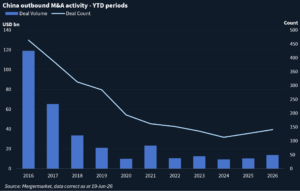
On the other hand, driven by capital deployment in mining, data centers, and energy projects, greenfield investment by Chinese firms reached USD 100bn in 2025, its highest level in more than 10 years, according to a Rhodium Group report. Over the past decade, the share of M&A in total Chinese outbound investment has fallen from 80% in 2016 to 49% in 2020 and only 21% in 2025, according to the same report.
Geography and sector drivers
The primary destinations for Chinese outbound greenfield investment are, according to a KPMG report, concentrated in Southeast Asia (particularly Indonesia, Malaysia, and Thailand), Europe (especially Hungary and the UK), the Middle East (led by Saudi Arabia and the UAE), and Latin America (notably Brazil and Chile). Investments in Belt and Road Initiative (BRI) partner countries dominate, accounting for over 85% of China’s total greenfield investment between 2013 and 2024.
The automotive industry, particularly EV and battery manufacturing, led investments in 2024, representing 34.5% of the total, followed by renewable energy, information and communications technology (ICT), and critical metal mining, according to the same report.
Among recent flagship greenfield investments by Chinese firms is electric vehicle battery maker CATL’s gigafactory in Debrecen, Hungary, which, as detailed below, is subject to review by newly elected Prime Minister Péter Magyar. Meanwhile, BYD will reportedly start assembling electric cars at its new Szeged plant in southern Hungary before the end of the year but has put construction of a plant in Turkey on hold.
In Indonesia, Chinese battery manufacturer Zhejiang Huayou Cobalt last year replaced South Korea’s LG Energy Solution as strategic investor in an USD 8.4bn project to build a local electric vehicle battery value chain. Meanwhile, a consortium of Chinese firms that include Tongkun, Xinfengming, and Tsingshan agreed to invest USD 5.9bn in a refinery and petrochemical plant in North Kalimantan.
In September 2025, the Republic of the Congo and Chinese oil and gas company Wing Wah signed a USD 23bn hydrocarbon agreement for the development of the Banga Kayo, Holmoni and Cayo permits with a view to increase the nation’s output to 200,000 barrels per day (bpd). And last month, China Railway Construction Corporation began construction of a USD 5bn aircraft maintenance complex in Dubai, UAE, with completion expected by 2030.
In just a few years, the strategic logic behind outbound investment has changed for Chinese firms. Historically, they relied on exports to serve overseas markets. In a bid to improve their competitiveness, they used outbound M&A to secure strategic assets and resources. Today, amid rising trade barriers and supply chain pressures, they increasingly favor greenfield investments and deep localization to leverage their technological strength and capture destination market shares.
Due diligence challenges
In this context, assessing the ethical, legal, and reputational risks associated with a potential overseas business partner presents several challenges, including:
- Access to primary records:
Geographical distance and language barriers make it more difficult for investors and their due diligence teams to verify the most fundamental business records, including license validity, shareholder registers, and filings that may eventually help identify ultimate beneficial owners.
There is disparity between jurisdictions regarding what is available and how one can legally access them. A significant portion of the world’s corporate registries remain offline or operate behind IP restrictions or paywalls.
Documents such as corporate filings and court rulings that are sometimes accessible online are rarely available in English. In some jurisdictions such as Thailand, they are not even fully digitized or open to public online access. In some other jurisdictions, different types of companies may be registered in separate registries.
- Political and cultural dynamics:
Distinct political and cultural contexts require specific scrutiny to assess their potential impact on investments. For example, businesses in the Middle East often feature politically exposed or socially prominent figures in boardroom roles, a practice that may raise questions among potential investors regarding the company’s operations and its access to state institutions.
In certain countries, a positive business development, such as the launch of a new electric vehicle assembly line, may trigger local community concerns over wastewater discharge, leading to protests and creating risks that can escalate if not properly assessed.
Administration changes and shifts in power between federal and state-level offices can also impact incentives across sectors.
Hungary’s Orbán administration, which recently ended its 16 years in government, welcomed multiple Chinese companies to build factories in the country, making China Hungary’s largest trading partner outside Europe, according to a December 2024 report by the Joint Conference of Chinese Overseas Chambers of Commerce and the Association of Chinese Enterprises in Hungary. In 2023, it reportedly promised millions of euros in tax breaks and grants to Chinese electric vehicle battery maker CATL for its gigafactory in Debrecen.
Now, as analyzed by Blackpeak, it is uncertain whether Chinese investors will continue to benefit from this policy stance and Péter Magyar, the newly elected prime minister, is reportedly considering a review of CATL’s gigafactory.
- Compliance regimes complexity:
Another salient challenge facing Chinese outbound investors is the divergence of regulations across jurisdictions. The existence of more than 50 foreign direct investment screening regimes means any single deal may be subject to a dozen national security, technology-protection, or foreign-policy constraints.
There is no database that offers global one-stop compliance screening, nor is there a global standard for ESG compliance or personal data protection. States apply fundamentally different models of data governance, meaning that a Chinese conglomerate investing in manufacturing lines in Europe and Southeast Asia need to comply with two different frameworks.
National security review, meanwhile, has expanded from the defense sector to a wider range of industries, such as advanced technologies or key resource supplies. The Committee on Foreign Investment in the US may even scrutinize strictly passive investments if they originate from “countries of concern” or related to certain sensitive technologies.
In April 2026, Sanan Optoelectronics terminated its planned acquisition of Lumileds Holding BV, a US-based LED and lighting components manufacturer. The deal, which was first announced in August 2025 and valued at USD 239mn, was called off after the Committee on Foreign Investment concluded that the transaction posed an irremediable national security risk and required the parties to withdraw their filing, which effectively terminated the deal.
While conventional financial and legal due diligence answers whether the target company is financially healthy and law-abiding, integrity due diligence and business intelligence capture early signals that are critical to sustainable operational success. Investors should look beyond historical records to identify emerging regulatory risks early, interpret whether minor infractions signal broader governance issues, and assess whether current operating practices could create long‑term shareholder risk.
- Regulation enforcement opacity:
Another difficulty frequently faced by Chinese investors is the opacity of how regulation is enforced in emerging markets. Rules can be selectively enforced in certain scenarios or drastically altered after an administration change or a shift in policy direction, making it critical to identify which ones matter the most in practice. Even when laws and regulations are clear, bureaucratic processes and dispute resolution may depend heavily on relationships with local power structures.
Between 2022 and 2023, Chinese mobile manufacturers in India, including Vivo and Xiaomi, faced sudden asset freezes, raids, and legal action with little regulatory warning or transparency.
As Chinese capital flows into consumer goods factories in Southeast Asia, integrated supply chains in Latin America, and infrastructure segments in the Middle East, institutionalized pre-deal integrity due diligence, complemented by discreet and local human source inquiries, is becoming increasingly critical. These efforts should be supported by jurisdiction-specific political and regulatory intelligence and sustained through periodic reviews to anticipate changes in circumstances.
A service of 

Navigate complex markets and risk with confidence. Today
Global due diligence specialists helping you stay ahead of uncertainty.