After Hormuz: The strategic chokepoints redefining global supply chain risk


- Bab al‑Mandab, Suez, Panama, Malacca among systemic supply chokepoints
- Pressure builds on just‑in‑time models while near‑ and friend‑shoring gains traction
- Intensified enforcement against “shadow fleets” risks military escalation in trade routes
Closure of the Strait of Hormuz represents the most significant and sustained use of chokepoint leverage in recent history.
Previously treated as a hypothetical risk, Iran’s so-far successful blockade shows that it can be executed in practice and used to pursue political concessions – and profit. The US counter-blockade targeting Iranian shipping activity in the Middle East and beyond, in turn, poses the risk of broader escalation across global maritime routes.
Beyond immediate market volatility, the Strait’s closure will have a lasting impact on how risk is assessed and priced across supply chain networks reliant on a handful of critical maritime chokepoints.
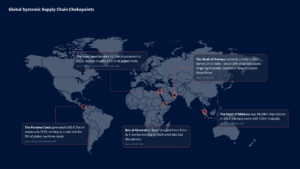
The vulnerability of trade corridors requires corporates and investors to factor in geopolitical exposure, maritime security, and sanctions enforcement as core elements of due diligence and physical asset security assessment.
This demands a more rigorous approach to supply chain due diligence that involves mapping which chokepoints a given supply chain must transit, identifying alternative routing if those corridors are compromised, and assessing cost differences under stress scenarios.
This new reality challenges the “just in time” approach to supply chain management and will likely accelerate trends toward near-shoring and friend-shoring, particularly in sectors tied to energy, defense, and critical infrastructure.
Yet geography and economics make certain dependencies unavoidable.
In this context, we look beyond the Strait of Hormuz at some of the world’s other critical supply chain chokepoints and the distinct dynamics and risks shaping their role in the global economy.
Bab al-Mandab Strait
The Bab al-Mandab Strait, situated across the Arabian Peninsula from the Strait of Hormuz, connects the Red Sea with the Gulf of Aden and the Arabian Sea, an essential corridor for the transit of oil and other goods between Europe, Asia, and the Americas.
Bab al-Mandab, Arabic for “Gate of Tears” due to its tricky navigation conditions, became the subject of increased attention following the October 7 attacks on Israel in 2023, when Iran-backed Houthi rebels in Yemen began targeting commercial vessels in the Red Sea and disrupting shipping flows through the Bab al-Mandab Strait. Carrier traffic through the Red Sea significantly declined as four of the five largest shipping companies paused or suspended service by the end of 2023, both due to the threat of Houthi attack as well as the restrictive effect of higher insurance and container prices.
Beginning in 2024, the US and its allies carried out sustained military strikes on the Houthis aimed at protecting shipping lanes and degrading the group’s military capabilities and infrastructure.
Following the October 2025 ceasefire between Israel and Hamas, the Houthis vowed to pause attacks in the Red Sea, but the persistence of elevated insurance costs demonstrates that confidence in critical trade routes can remain impaired even after conflict-related disruptions appear to subside.
Just as some shipping companies may have been considering returning to the Bab al-Mandab Strait and Red Sea, on April 19, the Houthis threatened to close the Strait in support of Iran. The move once again raised the prospect of disruption to critical Saudi oil exports. It also shows that instability in one chokepoint can rapidly cascade across interconnected maritime routes and global markets.
At the same time, the growing strain on US military assets in the Middle East raises questions about the availability of maritime security capabilities in the Red Sea and Horn of Africa, particularly as recent reports point to increasing concerns over coordination between Houthis and Somali pirate networks.
Suez Canal
The Suez Canal connects the Mediterranean Sea to the Red Sea, dividing Africa and Asia, and has served as a key trade route since its construction was completed in 1869.
Throughout its history, the Suez has repeatedly been drawn into geopolitical conflict. Most notably, during the 1956 Suez Crisis, Egyptian President Gamal Abdel Nasser nationalized the canal and disrupted transit in response to military pressure from the UK, France, and Israel.
In 2021, the Canal drew the world’s attention again when it was blocked in both directions for nearly a week after the Ever Given container ship ran aground, reiterating the potential for one-off black swan events to cause massive supply chain disruptions when a critical chokepoint is impacted.
More recently, instability in the Bab al-Mandab Strait has reinforced the vulnerability of the Suez Canal to disruptions at the Red Sea’s southern entrance. Houthi attacks on commercial vessels demonstrated how relatively inexpensive asymmetric tactics can impose disproportionate costs on global shipping and damage confidence in maritime transit.
War risk insurance premiums for vessels transiting the Red Sea surged to as much as 1% of a ship’s insured value per voyage following the onset of Houthi attacks. This rise, when applied to a vessel worth hundreds of millions of dollars, can make a single transit prohibitively expensive. The real-time repricing by underwriters reflects how quickly insurance markets internalize geopolitical risk, functioning as a live indicator of confidence in the security of a given trade corridor.
While the US and its allies responded with Operation Prosperity Guardian, the longest US naval engagement since World War II, the persistence of attacks highlighted the high cost of securing waterways against low-cost disruption.
As the Iran war continues, uncertainty over whether Western allies are willing to recommit to another prolonged Red Sea security campaign raises questions about the resilience of another critical Middle Eastern chokepoint.
Panama Canal
In the Western Hemisphere, the Panama Canal acts as a trade conduit between the Atlantic and Pacific Oceans. The 51-mile waterway is operated by the state-run Panama Canal Authority and uses a timeslot auction system to allow pricing to dynamically reflect demand and control congestion.
Reflecting how disruption at one chokepoint can have immediate effects across global logistics networks, shipping congestion tied to instability in the Middle East has pushed auction prices to record highs while increasing wait times.
The Panama Canal has also been central to the Trump administration’s foreign policy agenda, which aims to strengthen US influence in the Western Hemisphere.
In January 2026, under pressure from the US to “take back” the Panama Canal from Hong Kong shipping conglomerate CK Hutchinson, the Panama Supreme Court ruled that the contract allowing CK Hutchinson to operate two major port terminals was unconstitutional. CK Hutchinson is challenging the decision.
In the meantime, transit revenue has surged and water levels, which were impacted by drought conditions in 2023–2024, have normalized and can accommodate increased traffic.
Countering Chinese influence – in Latin America in particular – is a top priority for the Trump administration, especially considering the success that China has had in embedding itself in supply chain infrastructure through its Belt and Road Initiative.
The administration’s posture toward Venezuela, Greenland, and the Panama Canal suggests a broader strategic emphasis on securing influence over critical resources, infrastructure, and trade corridors, reflecting a recognition that strategic chokepoints may be as geopolitically valuable as the commodities that move through them.
Malacca Strait
Between Indonesia, Malaysia, and Singapore, the Malacca Strait connects the Indian Ocean to the South China Sea and serves as a primary maritime corridor connecting Asia to the Middle East and Europe.
Nearly a third of global oil passes through the 500-mile funnel-shaped waterway that is only 1.7 miles wide at its narrowest point near Singapore. While alternative routes exist, most notably the Sunda Strait between the Indonesian islands of Java and Sumatra, they are more costly and operationally inefficient.
Due to the number of economies dependent on uninterrupted transport through the corridor, the security of the Strait evolved into an issue worthy of a coordinated regional action.
In response to persistent incidents of piracy and maritime crime, Indonesia, Malaysia, Singapore, and Thailand established the Malacca Strait Patrol in 2004.
However, the growing strategic value of global chokepoints in a more fragmented geopolitical environment has begun to place new pressure on those assumptions.
In April, the Indonesian Finance Minister suggested implementing a toll system for the Strait of Malacca. Representatives from Singapore and Malaysia quickly responded by reaffirming their commitment to maintaining unimpeded transit through the Strait. Nonetheless, Indonesia’s proposal could foreshadow a broader shift among governments adjacent to maritime chokepoints in how they approach governance and revenue models.
For investors, the Strait’s importance in Southeast Asia, the region most impacted by the Strait of Hormuz blockade outside of the Middle East, extends far beyond shipping. The corridor sits at the center of both regional and global supply chains supporting manufacturing, semiconductors, and consumer goods industries in Asia. Prolonged disruptions or rising transit costs would ripple across sectors built on predictable maritime logistics.
China and the US have for years expanded naval activity across the Indo-Pacific, reflecting a broader strategic competition over contested waters and trade routes.
For China, which remains heavily reliant on the Strait of Malacca for energy imports, a vulnerability often referred to as the “Malacca Dilemma,” maintaining a stronger naval presence is seen as vital to protecting the flow of oil, including discounted crude from sanctioned Iran.
The US Navy has historically played a central role in safeguarding freedom of navigation and ensuring the passage of commercial vessels through the South China Sea and broader Indo-Pacific. However, under the Trump administration’s “America First” agenda, protection of free global shipping lanes is increasingly at odds with a more selective and transactional approach to maritime security.
At the same time, intensifying US enforcement of shadow fleets that undermine sanctions regimes suggests that key shipping corridors may face growing friction.
In April, American naval forces interdicted two Iran-linked tankers in the Indian Ocean, and if counter-blockade and sanction enforcement operations continue to expand in scope, naval encounters may further complicate maritime transit and raise the risk of military escalation.
Arctic Routes
An emerging factor in global shipping is the gradual opening of Arctic maritime routes as sea ice recedes along Russia’s northern coast.
For governments and investors alike, the prospect of shorter transit routes between Europe and Asia presents both an economic opportunity and a new arena for geopolitical competition.
Based on increased cooperation between China and Russia on high-priority issues, including the Arctic region, China sees an opportunity to address its “Malacca Dilemma” with the use of Arctic shipping lanes that connect Europe and Asia.
However, Russia does not appear inclined to operate the Northern Route as an open commercial waterway comparable to other international maritime corridors. Instead, Moscow has set up a legal framework that makes transit contingent on Russian authorization and control.
The Trump administration’s persistent interest in Greenland also reflects the growing strategic importance of the Arctic. The Northwest Passage, which travels along Greenland’s coastline, may become increasingly accessible to both polar-class vessels and conventional commercial shipping in coming decades.
Together, transit through the Northern Route and Northwest Passage could potentially cut shipping costs in half and reduce timelines by multiple days compared to traditional routes between Europe and Asia through the Suez Canal and Strait of Malacca. Yet, as with many of the world’s existing chokepoints, geopolitical tension and discretionary regulation may threaten to undermine the viability of passage and jeopardize the potential for reduced costs.
Looking Ahead
The world has entered a geopolitical environment in which once-cooperative systems of trade and maritime transit are increasingly leveraged not only for military advantage, but also for macroeconomic pressure and political concessions.
At the same time, the growing prevalence of shadow fleet networks – and expanding efforts to police them – are introducing additional friction into global shipping routes.
Even if the current blockade is eventually resolved, it is unlikely that risk calculations in global shipping will return to their previous baseline.
The demonstrated ability to disrupt a critical chokepoint like the Strait of Hormuz, even with a weakened military, has fundamentally altered how maritime routes are priced, insured, and secured. More broadly, the assumptions that underpinned decades of globalization, including open sea lanes and predictable commercial infrastructure, are becoming less certain.
A service of 

Navigate complex markets and risk with confidence. Today
Global due diligence specialists helping you stay ahead of uncertainty.