NFL legend Eli Manning backs RCX buyout as BVG targets youth sports growth


- RCX is BVG’s second youth sports investment after Score
- Independent sponsor set up dedicated sports strategy in 2022
- Value creation plan focused on increasing participation
Private equity’s approach to sports investing is broadening beyond franchise ownership.
After an initial wave of capital focused on major league teams, investors are now targeting adjacent businesses, from emerging leagues to technology platforms and service providers. This more diversified opportunity set helped propel North American sports M&A volume to a record USD 20.6bn in 2025, according to Mergermarket data.
“There’s a broader ‘picks and shovels’ ecosystem around sports that’s still relatively under the radar,” Drew Sheinman, a founding partner at New York-based independent sponsor Brand Velocity Group (BVG), told Mergermarket.

Sheinman
Earlier this month, BVG took a further step into that ecosystem with the acquisition of Roswell, Georgia-based RCX Sports, its second investment in youth sports following the 2022 purchase of uniform and equipment business SCORE Sports. Both demonstrate an emphasis on participation-driven growth.
BVG was an early mover in sports – it launched a dedicated strategy in 2022 – and the firm claims a unique blend of investing experience, operational expertise, and sports pedigree. Eli Manning, a partner at BVG and a two-time Super Bowl winner with the New York Giants, played a key role in the RCX deal.
“A big part of it was our authentic belief in, and passion for, youth sports,” said Sheinman. “There’s no better spokesperson for that than Eli.”
Culture is key
Sheinman, a former Endeavor executive whose prior experience includes senior marketing roles in professional sports, founded BVG in 2019 alongside Steve Lebowitz, a co-founder of Topspin Consumer Partners, and Austin Ramos, a private equity investor and former collegiate athlete.
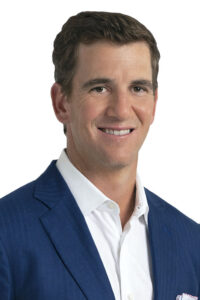
Manning
On one level, the agenda is classic middle market: buying companies with at least USD 10m in EBITDA and helping them scale through the application of marketing and operational expertise. But it is fused with a strong focus on culture and employee engagement.
“We wanted to differentiate ourselves from traditional private equity – to really lean into caring about employees and corporate culture on one side, while doing things differently from how many firms have operated historically,” said Sheinman.
This prompted the development of “Share the Gains,” a profit-sharing scheme that allocates 10% of BVG’s carried interest to employees across portfolio companies. It will be rolled out at RCX. Manning observed that the scheme helps create a sense of collective effort.
“I often compare it to winning a championship in football,” he told Mergermarket. “It’s not just the players and owners who get a Super Bowl ring, it’s everyone: equipment staff, cafeteria workers, film room staff. Everyone can say, ‘We’re champions,’ and share in that reward.”
Manning added that BVG’s independent sponsor model enables it to be selective, only pursuing high-conviction opportunities. “That means finding the right deal – one where we believe we can make a difference, grow the business, and ensure it aligns with our values and culture,” he said.
RCX, which counts NFL veteran Izell Reese as its founder and CEO, fit the bill. BVG had been tracking the company for several years, and it ultimately prevailed in a competitive process run by previous owner Raine Group.
The firm then assembled an investor consortium comprising Hamilton Lane’s Impact platform, St. Cloud Capital, Darco Capital, and Three Ocean Partners. Athletes took part as well, including Manning and fellow former NFL stars like Emmitt Smith, Larry Fitzgerald, and Jameis Winston.
North star
Private equity involvement in youth sports has drawn criticism in some quarters, particularly around rising costs and the commercialization of travel programs. A group of congressional Democrats has gone so far as to introduce a bill aimed at curtailing participation by such investors.
However, Manning stressed that BVG’s approach with RCX represents a different model, focused on accessibility and broad-based participation rather than premium pricing. It also aligns neatly with the goals of the big sports leagues, which are looking to develop their fanbases.
“The leagues want to grow fandom — they want kids playing sports, wearing team uniforms, engaging with their brands,” Manning explained. “At the same time, they want participation to be accessible and affordable.”
A central pillar of that strategy is flag football, where RCX is the license holder for NFL Flag, the official youth program of the National Football League (NFL). According to the NFL, around 4.1m young people play flag football in the US – up more than 50% since 2020 – with significant participation from girls. “RCX has already done so much for girls in sports—especially through flag football,” Manning noted.
Flag football is well established as a high school sport, with students in 39 states able to take part. Manning noted that it is now emerging at college level, while the sport’s inclusion in the upcoming 2028 Los Angeles Olympics further strengthens the outlook.
“We’re already starting to see momentum build – through events and exhibitions, and growing awareness of national teams,” Manning said. “The Olympics will introduce flag football to a much broader audience.”
RCX’s success in flag football could provide a blueprint for other sports. The company already delivers youth sports programs not only for the NFL but also Major League Soccer (MLS), the National Basketball Association (NBA), Major League Baseball (MLB) and the National Hockey League (NHL). BVG is keen to put its participation-based value creation strategy to work.
“If more kids are playing sports, that’s the key metric,” Manning said. “If you get that right, the investment performance will follow – that’s really the north star.”
Meanwhile, the sponsor is eyeing other opportunities across the broader sports ecosystem. Sheinman points to live events and areas that tap into the “human experience” of sports as key areas for growth, noting how investors are placing more value on the communal aspect of sports. Companies catering to fan engagement are another area of interest.
“The pipeline is very robust, which is a great position to be in,” Sheinman added. “That said, we’re very selective.”
A service of 

Your M&A Future. Today
Explore unlimited content like this, available only in the platform.
Already a client? Sign in