
Raízen requests extrajudicial restructuring in Brazil – Case Profile


Brazilian biofuels producer Raízen SA has filed for an extrajudicial reorganization with the support of 47% of the creditors subject to the restructuring. The joint venture between Shell and Cosan included nine group companies in its petition, covering BRL 65.14bn (USD 12.62) in claims to be restructured.
In the filing, Raízen mentioned changes in the macroeconomic and in the market conditions as factors which harmed its liquidity, resulting in harvest cycles with lower productivity, falling margins and high financial debt costs. It also noted that the increase in the Selic Brazilian benchmark interest rate, from 2% in 2020 to 15% in 2026, affected indebtedness “significantly.”
The restructuring plan proposes the issuance of a new debt and an equity capitalization, but Raízen did not initially specify the size of the new issuance, the amount of equity contribution or provide any other details. Raízen essentially presented a standstill agreement with creditors and said it would present an updated plan in the future.
In addition to the extrajudicial filing in Brazil, the group also plans to request recognition of the Brazilian proceeding in the US under a Chapter 15.
The company
Raízen SA is a joint venture between Shell Brazil Holding BV and Cosan Investimentos e Participações SA, operating with business units focused on the production of sugar, first and second-generation ethanol, bioenergy and on fuel distribution.
During the 2024-2025 harvest season, the group sold 3.4 billion liters of fuel, produced 5 million tons of sugar, 3 billion liters of ethanol, and generated 1.9 GWh of renewable energy, according to the company’s last integrated report.
In addition to Brazil, the group has business units in Argentina, where it is the second-largest player in fuel distribution, according the filing. In Argentina it operates a refinery and a lubricant plant, supplying 900 fuel stations.
The group is the world’s largest sugarcane processor. In fuel distribution, it ranks as the second-largest distributor in Brazil and Argentina, supplying service stations, logistics operators, airports, power plants, hospitals, and other strategic clients, according to the company’s petition. It is also among the leading global traders of ethanol and sugar.
Raízen was created in 2010 as two separate joint ventures, Raízen Energia SA and Raízen Combustíveis SA, with each partner owning approximately 50% of each JV. The Brazilian sugar and ethanol company Cosan transferred sugar, ethanol, energy, fuel distribution and logistics assets worth USD 4.9bn, and USD 2.5m in debt, to the JVs, while Shell pledged to contribute fuel-distribution units and USD 1.6bn within two years and a contingent injection of USD 300m over five years.
The deal included an option for each shareholder to buy out the other’s stake in 10 years, which was cancelled in 2016. In 2021, the shareholder agreement between Shell and Cosan was updated to include a corporate restructuring, under which Raízen Combustíveis SA (now renamed Raízen SA) incorporated all the shares of Raízen Energia, making Shell and Cosan direct shareholders of Raízen SA.
At present, Cosan SA owns 5% of Raízen SA, Cosan Nove Participações has a 39.02% stake, while Shell Brazil owns 44.024% of the company. Raízen SA owns 99.99% of Raízen Energia SA, beneath which the sugar and ethanol subsidiaries are located.
Cosan SA is mostly owned by several holding companies belonging to Rubens Ometto Silveira Mello, its founder and controlling shareholder. Cosan SA also owns 100% of Cosan Nove ordinary shares.

Under the current shareholder agreement, Cosan Nove, Cosan SA, and Shell each nominate three members to the board of directors, with one of Cosan’s nominees being Ometto Silveira Mello.
Raízen was listed on the Brazilian stock market, B3, in 2021, raising BRL 6.7bn. The company trades with the ticker RAIZ4.
The debt
Raízen SA reported BRL 98.63bn in debt in its petition. Of this total, BRL 65.14bn represents claims subjected to the proceeding, while BRL 33.49bn is intercompany claims. The Brazilian biofuels company said it had 47% of support from creditors with claims subject to the debt restructuring.
Raízen ended 2025 with a cash position of BRL 17.3bn, while net debt was BRL 55.5bn, as reported. Raízen’s net debt-to-adjusted EBITDA ratio was 5.3x at the end of 3Q25-26, compared to 3x a year earlier.
The debt to be restructured includes USD 5.5bn in six international bonds. This consists of the USD 500m 5.3% senior unsecured 2027, USD 750m 6.25% senior unsecured 2032, USD 1bn 6.45% senior unsecured 2034, 1bn 5.7% senior unsecured 2035, USD 1bn 6.7% senior unsecured 2037 and USD 1.250bn 6.95% senior unsecured 2054 notes. There is also BRL 6.4bn in eight domestic bonds.

Some bondholders have already signed on to support the extrajudicial plan, according to the list of parties signing the extrajudicial restructuring petition. The main creditors supporting the petitions include the ad hoc group of international bondholders, representing 11.4% of the total claims subjected to the proceeding. Other creditors also pledging support include the bank lenders Itaú Unibanco, BNP Paribas, Bank of America and Bradesco, Rabobank and Sumitomo Mitsui Banking.
The descent
The first warning sign of a possible debt restructuring at Raízen emerged on 2 February, when one of its controlling companies, Cosan, announced the redemption of its 2030 and 2031 bonds. The two Cosan bonds had cross-default clauses with Raízen’s bonds.
However, the hiring of legal and financial advisors days later took bondholders and creditor banks by surprise. This was not only due to the speed of the measure, but also because the Brazilian biofuels company was not facing liquidity constraints.
Raízen ended 2025 with a cash position of BRL 17.3bn, of which more than 90% was immediately liquid. It also had USD 1bn under a revolving credit facility.
The borrower was, however, in need of addressing its capital structure, given its high leverage and continuous negative cash flow generation.
Raízen has structured its activities around two main pillars: the production and commercialization of ethanol, sugar and bioenergy; and the distribution and sale of fuels, biofuels and lubricants.
The high leverage is a result of its aggressive growth strategy with the goal of consolidating its position as a global producer of renewable energy. It made significant investments in the acquisition of mills and in the construction of second-generation ethanol plants, as well as acquisitions of fuel distribution businesses in Argentina and Paraguay.
The sugar and ethanol business in particular requires large capex to support the quality of plantations and agricultural productivity. The activity is also exposed to event risk, including weather conditions.
Sugar and ethanol accounts for approximately 25% of the company’s net operating revenue, while the fuel distribution segment is responsible for approximately 75%.
The Brazilian scenario of high interest rates, at levels above 12% per year for 20 months – and 15% in the last eight months – has increased Raízen’s financial costs and is affecting its cash flow generation.
Raízen has been conducting, since late 2024, a plan aimed at improving its operational efficiency and its capital structure, including divestments, exit from some operations, reduced capex and dividends.
Through November 2025, the volume of divestments totaled approximately BRL 5bn. Raízen reduced the number of sugar and ethanol mills from 30 to 24, and proceeds would be used exclusive for deleverage. It is also in advanced negotiations to sell its Argentina assets – including an oil refinery and a network of more than 800 gas stations – valued at USD 1.5bn-USD 1.9bn.
At the time, Raízen dismissed any debt restructuring speculation, noting that it had a solid cash position. Meanwhile, shareholders discussed a capitalization and sought a third-party investor.
The recent engagement of advisors led Raízen to lose its investment-grade rating, dropping directly into the speculative-grade category. Rating agencies also drew attention to a worsening in the assessment of corporate governance.
Initially, Shell and Cosan planned a capitalization of BRL 3bn, with BRL 1.5bn from Shell, BRL 1bn from Cosan and BRL 500m from Aguassanta – the holding company owned by Rubens Ometto, founder and controlling shareholder of Cosan.
Cosan then began working with BTG Pactual on a multi-step plan to provide a “definitive solution” for Raízen’s capital structure, including a capital injection of around BRL 6bn from the bank’s private equity funds into the fuel distribution business, which would be separated from the sugar and ethanol production business. BTG Pactual Holding and funds managed by BTG Pactual Asset Management became Cosan shareholders in November 2025, following the completion of Cosan’s BRL 10.5bn capitalization.
Shell, in turn, decided to increase its capital contribution to BRL 3.5bn. Cristiano Pinto da Costa, CEO at Shell Brasil, publicly stated that he expected Cosan to match the offer. He also said that he was not opposed to a division of Raízen’s assets, but that the ideal solution would be to first recapitalize the company and then discuss a spin-off.
In response, Cosan decided against making a direct capital injection into Raízen. Ometto’s holding company has maintained the proposed BRL 500m contribution. Thus, the proposed capital contribution would total BRL 4bn, including the BRL 3.5bn from Shell.
The case
The case has been assigned to the Third Court of Bankruptcies in São Paulo, under judge Guilherme Cavalcanti Lamêgo.
The petition includes Raízen SA, Raízen Energia, Raízen Fuels Finance, Raízen Trading, Raízen North America, Raízen Caarapo Açúcar e Álcool, Raízen Centro-Sul Paulista, Raízen Centro-Sul and Blueway Trading Importação e Exportação.
In Brazil, an extrajudicial proceeding is similar to a US prepackaged Chapter 11 proceeding. A company may file for an extrajudicial bankruptcy proceeding with the approval of at least one-third of the claims to be restructured and then has 90 days to reach more than 50% of the claims in a class to be impaired.
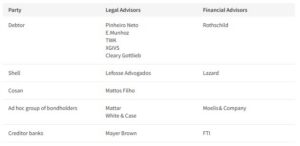
The advisors
Related links (Access Required):
Extrajudicial Petition (in Portuguese)
Restructuring Plan
Creditor list
Debtwire Restructuring Database: Raizen SA
Shareholder Profile: Ometto family (Cosan)
Legal Analysis Raizen SA
A service of 

Start your trial. Today
Explore unlimited content like this, available only in the platform.
Already a client? Sign in