Antares may be big but it’s still growing


- When Antares launched 30 years ago with seed capital of USD 1bn, ‘none of us could have predicted how large private credit would become’, says CEO Timothy Lyne
Becoming a private credit giant takes time – decades, even. From a germ of an idea and seed capital of USD 1bn in 1996, Antares has grown from a middle market direct lender into a diversified credit manager. And it’s still growing.
Three decades after the company was launched, founding partner and CEO Timothy Lyne is excited about moving into new market segments such as credit secondaries, but he is careful to ensure that the firm keeps the DNA that helped it amass about USD 96bn in assets through many moments of upheaval in the past.
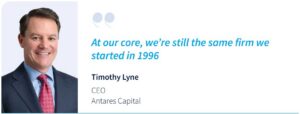
“At our core, we’re still the same firm we started in 1996,” says Lyne. “We’ve invested through the dot-com downturn, the global financial crisis and Covid, and you learn a lot through those cycles. That experience makes you better at assessing risk.”
As the firm celebrates its 30th birthday, Lyne has been in a reflective mood, looking back to the earliest days of the firm and the ideologies that were baked into it from the very start. In the early ’90s, the company’s 12 founders were all working together at Heller Financial. Back then, the US private credit market was just a twinkle in the eye of the leveraged finance industry. No-one could have predicted that this niche sector would grow into a USD 2tn behemoth by 2026.
A unique culture
Lyne remembers when he and his Heller colleagues were financing small to mid-sized companies. One team member, Barry Shear, saw an opportunity to build something different, he recalls: “Our own firm focused exclusively on sponsor-backed middle-market lending, where we could make decisions quickly and be more responsive to our clients.”
Their plan was to build a new company focused on financing private equity buyouts. All they needed was a capital partner who was prepared to back the team and give them the authority to make their own credit decisions. Through a personal connection, Shear was introduced to life insurer MassMutual. Antares arrived on the scene with a seed investment of USD 1bn from MassMutual, along with a “meaningful” amount of capital from the 12 founders.
“We believed we could build a better model,” says Lyne. “One where we were aligned as owners, made our own credit decisions and could respond to clients quickly. If a sponsor needed an answer on Thanksgiving Day, we could get the credit committee together and give them one.”
Between 1996 and 2005 Antares invested exclusively on behalf of MassMutual, but by 2005 the business had grown substantially enough that it needed access to a larger capital base to support the next phase of its growth. This ultimately led to MassMutual selling Antares to GE.
“We were initially skeptical about selling to GE because protecting our credit process and culture was critical to us,” says Lyne. “To GE’s credit, they agreed that the Antares team would lead the combined business on credit decisions and other key operating matters, and they preserved the Antares name.”
Before acquiring Antares, GE had acquired Lyne’s former employer Heller Financial. Later, GE would go on to acquire Merrill Lynch Capital, in a move which Lyne says allowed the firm to bring together “significant talent and capabilities across middle-market lending”.
By this point, middle market investing was growing rapidly in popularity, and Antares was at the forefront of innovation. In 2007, the firm developed the unitranche structure in cooperation with Allied Capital (now owned by Ares).
“We initially thought sponsors would use it primarily during periods of market dislocation,” says Lyne. “Instead, they embraced it and were willing to pay a premium for the speed, certainty and simplicity it provided. The market quickly caught on, and what we thought might be a solution for periods of dislocation ultimately became a fundamental shift in how sponsors financed their businesses.”
The combination of long-term market expertise and the ability to spot an opportunity in a fast-evolving market allowed Antares to survive the global financial crisis, but there was more disruption on the horizon for the tight-knit team. In 2015, GE placed Antares up for sale, and CPP Investments became the firm’s new owner, setting the stage for the next phase of its growth.
“CPP Investments had already identified private credit as an attractive long-term opportunity and initially explored building the capability organically,” said Lyne. “But they recognised that sponsor relationships and the experience required to succeed in this market take decades to build. When Antares became available, they saw an opportunity to acquire an established platform rather than build from scratch.”
At 20 years of age, Antares now had a big question to answer – was it time to open up the platform to third-party investors for the first time?
“We did the work, became convinced the opportunity was there, and our first formal fundraising generated USD 3bn,” said Lyne. “That became a major inflection point in Antares’ evolution from a balance-sheet lender to an asset manager.”
Vivek Mathew, president of Antares Capital Advisers, got to know the firm when he was hired by GE to advise on the sale of the business in 2015.
“I had spent more than a decade in credit and thought I knew virtually every major player in the market, but I really didn’t know Antares,” he says. “Here was a market-leading business with a nearly 20-year track record that had largely operated outside the institutional spotlight. The more I learned about the platform, the people and the culture through the sale process, the more compelling I found it. That experience ultimately led me to join Antares in 2016.”
He took the Antares story around the world, impressing investors who thought they knew every major player in the direct lending space.
“Antares had a tremendous reputation with private equity sponsors, but what struck me was that two important parts of the financial ecosystem barely knew the firm,” Mathew remembers. “Institutional investors didn’t know Antares because it hadn’t historically raised third-party capital, and Wall Street didn’t know it particularly well because the firm hadn’t needed to rely on the capital markets for financing.
“I remember thinking: this is a fantastic company with a nearly 20-year track record and a leading position in its market, yet it hasn’t really been introduced to these major constituencies. To me, that represented an enormous opportunity.”
At this stage, the firm had roughly USD 12bn in assets under management (AUM) and very little third-party capital, but Mathew knew the asset management business had the potential for huge growth. Two years later, in 2017, Mathew initiated the firm’s private credit and broadly-syndicated loan (BSL) CLO strategies, and Antares officially entered the CLO market with the largest CLO pricing since the global financial crisis. The firm raised USD 2.1bn for its debut issuance, a middle market deal named Antares CLO 2017‑1.
“That first CLO helped demonstrate that there was real institutional demand,” said Mathew. “Antares went on to become a consistent issuer, and the private credit CLO market itself became much larger and more institutional. That’s something I’m very proud of because it wasn’t simply about creating financing for Antares – it gave institutional investors access to an attractive opportunity, the premium for holding high-quality, less-liquid private credit, and helped broaden the market as a whole.”
In 2023, the firm issued its first BSL CLO to the market. By the time of writing, the firm had issued 8 BSL CLOs and 25 middle market CLOs in the US. Now, the firm’s focus is shifting towards credit secondaries. Last year, Apollo veteran Olga Kosters was hired as managing director and head of credit secondaries, to drive the expansion of Antares’ credit secondaries investment strategy. The firm has pledged to continue to build out a dedicated credit secondaries team as it sees significant opportunities to apply its expertise in this growing area.
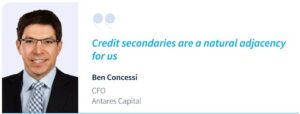
“Credit secondaries are a natural adjacency for us,” says Antares’ CFO Ben Concessi. “Our advantage is that we’re approaching the market as credit underwriters. We often know the individual companies in these portfolios, and in many cases we’ve already underwritten or invested in them. We believe that gives us a differentiated ability to assess risk and provide liquidity solutions to GPs and LPs.”
Meanwhile, Antares has not abandoned its core principles of sponsor-backed middle market lending. In May, the firm closed its third senior loan fund with USD 8.5bn, exceeding its initial targets with the backing of new and existing investors.
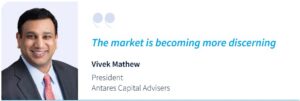
Mathew believes that differentiation will increasingly define this market, noting that investors are looking more critically at how managers invest and where performance is coming from. “Ultimately, I think the next phase will favour managers that can combine scale with real credit expertise, active management and a demonstrated ability to perform through cycles,” he says.
Amid myriad predictions of manager dispersion and market consolidation, this track record and the ability to continue to spot a new trend has helped Antares to stay at the top of investors’ minds.
“None of us could have imagined how large private credit would become, but that focus and those relationships have remained at the heart of Antares for 30 years,” says Lyne. “One principle has never changed: long-term outperformance starts with limiting losses. As we’ve grown, we’ve never strayed from the credit discipline that has defined Antares from the beginning.”
As the firm looks towards the next 30 years, Concessi says that the team is committed to applying what Antares has already built to a broader opportunity set. That means continuing to invest in people, technology and platforms while expanding into areas like credit secondaries, liquid credit and insurance.
“We’re not interested in growth for growth’s sake,” says Concessi. “We want to grow in areas where we have a clear advantage and where we can create meaningful value for investors. We want to evolve without losing what made Antares successful in the first place.”