
Albany (NY) experiencing cash crisis as questions over spending decisions swirl – Red Flag Report


Albany is facing a projected multi‑million‑dollar structural deficit and cash crisis that could pressure its credit profile, as revenue shortfalls and spending decisions that emerged earlier this year continue to draw scrutiny.
Double‑digit shortfalls expected for FY25 and FY26
In March, Mayor Dorcey Applyrs (D), who took office on 1 January, said the city is facing an expected USD 15m deficit in FY25 (ended 31 December 2025) and a projected USD 22m shortfall in FY26.
Applyrs, who served as Albany’s chief auditor from 1 January 2020 until assuming the mayoral role, implemented a hiring pause, limits on non‑essential spending and enhanced city‑wide financial oversight measures in response. In a WAMC report she was cited as saying she was unaware of the deficit projections until shortly before taking office.
Last week, the mayor said that the shortfalls are largely attributable to weaker‑than‑expected revenue collections, according to a WRGB article. The city lost USD 4.2m from now‑expired federal aid, USD 2m from lower‑than‑expected payments in lieu of taxes, USD 2.67m from soft sales tax collections, USD 2.46m from a decline in speed‑enforcement camera revenue and USD 314,000 from lower‑than‑expected property tax receipts. Unbudgeted overtime costs of about USD 2m also added pressure, the report said.
BAN and RAN sales, risky transfer eyed to close gaps
On 11 March, the city sold USD 142.9m of bond anticipation notes (BANs) in a competitive sale that was completed one day later than originally scheduled, according to a 10 March erratum notice posted on the Fiscal Advisors & Marketing Inc website.
The notice said the city has not needed to borrow for cash‑flow purposes since FY16 due to a previously strengthening financial position, but warned that current cash‑flow conditions and uncertainty around state revenues could require the issuance of revenue anticipation notes in 2026.
During a 15 April Finance, Taxation and Assessment Committee meeting, Chair Meghan Keegan said the city’s Board of Estimate and Apportionment (BEA) is likely to request a USD 12m transfer from the general fund to close the books on FY25, while rolling USD 3m of that amount into FY26. She said the move would exceed 4% of the city’s budget, as outlined in its charter, and could have negative credit implications.
“My concern is that [the transfer] would have a significant impact on the city’s bond rating and make future borrowing much more expensive,” Keegan said at the meeting. She added that the transfer would leave the city with no cash reserves in its debt reserve fund, increasing the risk of deficit spending and potential state oversight.
Keegan also cited a 2 December 2025 BEA vote approving a USD 6.4m transfer from the debt service fund to cover police overtime, health insurance and contingency costs. She said the common council should have been required to approve that transfer and will be asked to vote on the proposed USD 12m transfer.
Salary hikes, new positions created amid cash crunch
Albany received a “moderate fiscal stress” score in FY24 (ended 31 December 2024), according to State Comptroller Thomas P. DiNapoli’s (D) latest Fiscal Stress Monitoring System report. During last week’s committee meeting, officials noted the city has appeared on the state’s fiscal stress list 11 of the 13 times it has been published.
Despite its fiscal challenges, Applyrs secured approval for new administrative positions and salary increases for certain city officials weeks before publicly disclosing the budget shortfalls, the Albany Times Union reported.
The mayor’s office said the hiring and salary decisions were made before the scope of the deficits became known. Approved increases included raises for Deputy Mayor Christopher Ellis and Deputy Administrative Services Commissioner Kendell Demby, as well as the creation of two commissioner‑level roles following the split of the Department of Recreation, Youth and Workforce Services.
Recent trading activity
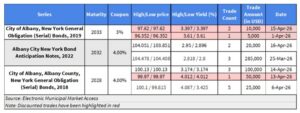
Electronic Municipal Market Access (EMMA) disclosures show discounted odd‑lot trading in the city’s Series 2019 serial general obligation bonds, which last traded slightly below par on 15 April. The city’s Series 2022 BANs last traded in odd lots above par on 16 April.
Albany’s long‑term debt is rated AA by S&P Global Ratings. The city had about USD 80m of general obligation debt outstanding at the close of FY24, according to its latest audited financial statement filed on EMMA.
Table: Trade activity in selected bond series with varying maturities
A service of 

Start your trial. Today
Explore unlimited content like this, available only in the platform.
Already a client? Sign in