Hong Kong’s IPO comeback brings growing risks and heightened regulatory scrutiny


- Hong Kong IPO momentum continues with 27 new listings year-to-date
- SFC scrutiny intensifies as sponsors face higher diligence expectations
- Rising SE Asian listings heighten cross‑border due diligence needs
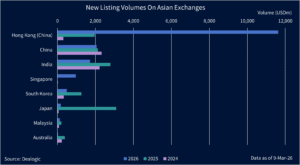
Since 2024, Hong Kong’s IPO market has staged a rebound which, according to Dealogic, culminated in 116 new listings in 2025, the highest number since 2020. Yet behind the surge in new issuances lies mounting concern over declining application quality and increasingly stringent regulatory expectations.
Favorable policies by both the China Securities Regulatory Commission (CSRC), China’s main capital markets regulator and HKEX, Hong Kong’s stock exchange operator, have encouraged Chinese and foreign firms to choose Hong Kong for their debut or dual listings. So far this year (as of 9 March 2026), Hong Kong has recorded 27 new listings, raising a combined USD 11.6bn and already surpassing the USD 11.3bn raised in the whole of 2024.
Since 2023, the CSRC has shifted from an approval-based regime to a filing-based regime for all Chinese companies listing overseas (including Hong Kong).[1] Under this approach, companies simply notify the CSRC by filing required documents rather than waiting for formal approval, streamlining and accelerating the listing process.
HKEX has also optimized its listing rules. In October 2024, it launched a fast‑track 30‑day review process for qualifying A‑share listed companies. In May 2025, it introduced the ‘Technology Enterprises Channel,’ providing specific listing guidance and a confidential application channel for biotech companies under Chapter 18A and specialized technology companies under Chapter 18C.[2]
In recent years, HKEX has also relaxed listing thresholds by allowing weighted-voting rights structures, listing for unprofitable biotech and specialist technology companies, and introducing the SPAC mechanism.
Meanwhile, southbound capital flowing through the Shanghai–Hong Kong and Shenzhen–Hong Kong Stock Connect programmes recorded a net inflow of HKD 1.4 trillion in 2025. This sustained Mainland investor demand for Hong Kong–listed equities effectively offset the withdrawal of foreign funds and materially strengthened overall market liquidity.[3]
Rising regulatory scrutiny on declining IPO applications standards
However, Hong Kong’s fundraising boom has raised concerns from regulators over substandard work and poor applications by investment banks.
In January 2026, the Securities and Futures Commission (SFC), Hong Kong’s independent statutory regulator, issued a circular, highlighting sponsors’ deficiencies in fulfilling their gatekeeping responsibilities during the IPO preparation process, and listed several examples of shortcomings, including:
- Documents lacking analysis of the applicant’s operational risks, such as fluctuating financial performance and management misconduct.
- Documents showing insufficient review and analysis of regulatory violations, legal proceedings and sanctions risks, as well as cross-jurisdictional litigation exposure.
- Documents lacking a reasonable explanation and justification for the applicant’s deteriorating financial performance.
- Applications lacking analysis of the applicant’s market position and industrial competitive landscape.
- Documents missing key information on the applicant’s tax liability and updates on the legal proceedings related to tax liability.
- In one case, failure to disclose bribery allegations involving directors and controlling shareholders.
- Lack of evidence demonstrating the listing eligibility of certain biotechnology or specialized technology companies, including core product development, patents, revenue thresholds, and experienced independent investors.[4]
- Documents using promotional language or immaterial information instead of factual disclosure, which risks misleading the market.
Insufficient research and risk disclosure across an issuer’s operations, financials, legal and compliance matters, or reputation can delay or derail a listing and expose sponsors to regulatory action.
In December 2025, the SFC and the HKEX issued a joint letter to 13 sponsors in Hong Kong, warning about the quality decline and non-compliant practices observed in new listing applications. The January 2026 SFC circular further warned that severely deficient listing applications may be returned or suspended, and that serious sponsor failures may trigger regulatory action, including restrictions on their business scope or deal pipeline.[5]
The circular also signaled a tightening of sponsor oversight, including caps on the number of IPO applications to prevent over-commitment, stricter qualification reviews of sponsor personnel, and the use of “vetting suspension” as a lever to reinforce sponsors’ accountability during the preparation of listing documents.
Under increasingly stringent regulatory oversight, only a systematic review of all the operational and compliance aspects and a comprehensive verification of eligibility elements can ensure the quality of IPO disclosures and meet the SFC’s requirements. In practice, IPO stakeholders must adhere to a rigorous due diligence methodology, including:
- Conduct deep financial analysis to fully understand potential fluctuations in revenue, profit, or cash flow.
- Investigate the company’s directors’ and controlling shareholders’ criminal history, regulatory breaches, and conflict‑of‑interest disclosures.
- Establish eligibility for biotech and tech applicants by probing core product development status, patent strength, and revenue/valuation thresholds.
- Gather sector‑specific intelligence from experts (especially for 18A and 18C biotech and specialized technology listings) to validate scientific progress, IP, clinical data, and engineering milestones.
- Do not rely on information provided by applicants and document all due‑diligence steps to reduce regulatory exposure.
- Track regulatory changes relevant to listing regimes such as Chapters 18A/18C to ensure disclosures or eligibility obligations continue to be met by the applicant.
- Ensure that governance structures such as boards, committees, and internal controls meet SFC expectations.
- Assess sanctions, export controls, and industry‑specific regulatory risks for applicants operating across multiple countries.
- Investigate the applicant’s suppliers, customers, authorized distributors, and licensing exposure across jurisdictions.
Southeast Asian companies turn to Hong Kong for listing
Beyond issuers from mainland China, HKEX is drawing increasing interest from Southeast Asian companies.
In March 2025, HKEX included the stock exchanges of Singapore, Indonesia, and Thailand on its Recognized Stock Exchange list, in effect simplifying secondary listing applications for Southeast Asian issuers.
This and the abovementioned reforms have helped attract emerging‑sector companies from Southeast Asia to pursue primary or secondary listings in Hong Kong.
Singapore-headquartered biotech firm MiRXES was listed on HKEX in May 2025, raising more than HKD 1bn (USD 138.9m) and becoming the first Southeast Asian unicorn on the HKEX.[6]
GSM (Green and Smart Mobility JSC), a Vietnamese electric-vehicle taxi operator, reportedly plans to raise at least USD 200m through an IPO in Hong Kong in late 2026 to early 2027 at a valuation of USD 2bn – USD 3bn. And Thailand’s Minor Food, a subsidiary of Minor International, is also reportedly considering a listing in Hong Kong.[7]
For Southeast Asian issuers navigating the Hong Kong market, cross-border due diligence becomes even more critical. Differences in corporate structures, local regulatory environments, and disclosure practices can create additional compliance and reputational risks.
Looking ahead, ongoing regulatory and market‑access reforms and expanding regional interest are poised to sustain Hong Kong’s strong listing momentum. Yet only those issuers and sponsors able to meet the SFC’s heightened standards and mitigate multi‑jurisdictional risk will capitalize on Hong Kong’s growing role as the region’s leading capital‑raising hub.
Blackpeak is trusted by top financial institutions globally, with a specialized due diligence approach to comprehensively assess risks; from discreet investigations to desktop research, industry interviews and site visits. We ensure each opportunity is leveraged for optimal outcomes and delivers to you actionable insights that drive informed decision-making.
Want to learn more about how Blackpeak can help you?
Get expert guidance now by connecting with one of our specialists.
[1] https://www.csrc.gov.cn/csrc/c100028/c7474875/content.shtml
[2] https://www.hkex.com.hk/News/Regulatory-Announcements/2024/241018news?sc_lang=zh-HK; https://www.cls.cn/detail/2295401
[3] https://finance.eastmoney.com/a/202601043607819332.html
[4] https://apps.sfc.hk/edistributionWeb/api/circular/openAppendix?lang=TC&refNo=26EC4&appendix=0
[5] https://apps.sfc.hk/edistributionWeb/api/circular/openFile?lang=EN&refNo=26EC4
[6] https://www.ipox.com/ipo-calendar/mirxes
[7] https://www.chinadailyasia.com/hk/article/626195; https://marketech-apac.com/minor-international-eyes-hong-kong-listing-for-food-business-amid-growth-drive/
A service of 

Navigate complex markets and risk with confidence. Today
Global due diligence specialists helping you stay ahead of uncertainty.